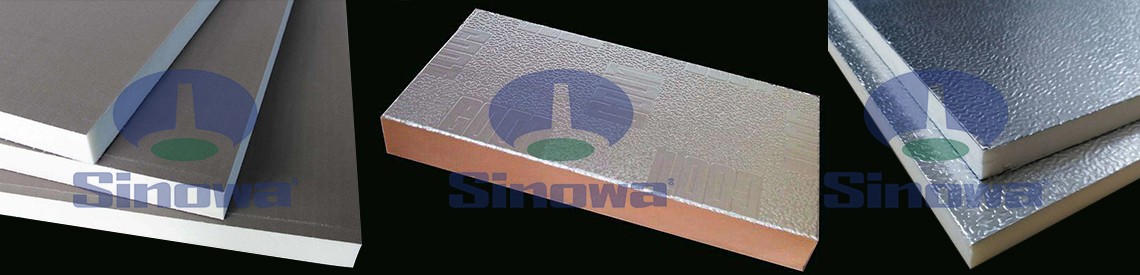
Sinowa is a well-known Automatic Insulation Panel Machine Supplier From China, Continuous Insulation Panel Production Line of the PU and phenolic aldehyde surface has diversified and multifunctional production characteristics, which may produce products with different specifications such as PU, PF, PIR, etc.
The surface material may be aluminum foil, colored steel, cement base cloth, kraft paper, non-woven fabrics, etc.
The products are widely applied to such occasions as construction, decoration, pipeline ventilation, subway construction, etc.

The automatic insulation panel machine of soft layer insulation board is able to continuously and efficiently produce high-quality PU and Phenolic insulation boards.
We spare no efforts to improve our product quality and technological reliability by employing the most cutting-edge and the most reliable support and processes to make our products highly reliable and endurable. As a result, the automatic insulation panel machine of our soft layer insulation panels is highlighted by many perfect qualities. It is the core idea in Sinowa's product roadmap to surpass our competitors in terms of design philosophy, manufacture methods and service level, going for excellence and leading position and making constant improvement on our products and services, which is also our core value system to create efficiency and convenience for our customers.

Well-grounded on our solid strength as a renowned large-scale enterprise, Sinowa has a high starting point in developing industrial assembly lines.
Based on the advanced science and technology introduced from within and without the country and supported by a great number of first-grade parts and components from the home and aboard, these assembly lines have a high-level configuration of supporting products in terms of machinery, electrical control, hydraulic pressure, automatic measurement and tracking, and so on.
This is a strong proof of our product’s reliable quality and high efficiency.

The first-class appearance design and excellent energy saving measures make it unnecessary for customers to additionally construct the heat preservation and isolation room for production around the clock throughout the year, so that the customers may save lots of resources and costs.
Modularized standard design and important parts machined with CNC machine tool make the production line have excellent quality assurance. Dependence on the man-made factors is eliminated. The operation is precision, with the highest operation speed of 30m/min. The automatic insulation panel machine has the world-class production efficiency.

The high performance and reliable multicomponent cyclopentane foaming technology and equipment of Sinowa may be also applied to the foaming process of the phenolic aldehyde board. Therefore, our customers may not only freely adjust the foaming matching according to the raw material, but also save lots of costs. Moreover, they are of significance for environmental protection.
Sinowa's industrial automatic insulation panel machine of insulation panels is distinguished by its impressive performance of energy conservation. In each high point of energy consumption throughout the entire pu sandwich panel line are implemented corresponding measures to considerably lower the consumption level.

For example, the body of the lamination belt conveyer is covered with insulation panels in very reasonable structures, which doesn’t blemish the overall outlook but greatly increases the insulation performance.
The entire automatic insulation panel machine is constantly optimized and improved so that the consumption of each power source is significantly reduced. The motor power of our lamination conveying system is only 3.0 kw, about 50% less than those of the same kind.
All in all, the energy consumption of the whole sandwich panel line equals 40% or even less of the equivalent lines in the market.

The automatic insulation panel machine of Sinowa adopts the most advanced concepts in the world to realize the modularized design with all the parts bolted together rather than welded.
In standardized production, the parts can be dismantled and exchanged, so the production cycle is drastically shortened and the maintenance becomes by far easier.
Through finite element analysis, the equipment design is greatly optimized to realize modularization, digitization, and weight-minimalization.
| PRODUCTION TYPE | PU | PIR | PHENOLIC | |||
|---|---|---|---|---|---|---|
| PRODUCTION USE | INSULATION PANEL | DOCORATIVE PANEL | ||||
| SURFACE OF SHEET | ALUMINUM FOIL | NON-WOVEN FABRIC | PAPER | NAKED | ||
| PRODUCT THICKNESS | 10m--- 200mm | |||||
| PRODUCTION SPEED | 3.0m---25m |
|---|---|
| FOAMING METHOD | TWO OR MULTI COMPONENTS FOAMING |
| FOAMING AGENT | PENTANE OR 141B |
| LENGTH OF LINE | 45m—100m CUSTOMER OPTIONAL |
Sinowa is a well-known manufacturer and technical service provider of high-end polyurethane insulation board production lines and various high-performance cold roll forming machine in China. Our main products include polyurethane double-sided color steel sandwich panel production line, polyurethane and phenolic soft facing insulation panel production line and high-efficiency roll forming machines.
Sinowa has invested outstanding efforts in automatic insulation panel machine, This is why our products are more efficiency, quality, automatic control technology, environmental protection, energy consumption indicators and the appearance and safety protection are comprehensively leading, Some subversive design changes in many major technical points,these major innovations make our products excellent in price/performance and user experience.
Sinowa is committed to the development and manufacturing of high-end and high-efficiency automatic insulation panel machine. Our sandwich panel production lines are leading the way in efficiency, automatic control, human-computer interaction, environmental protection and energy consumption. Using system integration and bus control technology, it realizes the automatic integrated linkage control of the entire production line, and can achieve remote interactive communication, which has the world-class level and a comprehensive leading high-performance production line in the market.
The automatic insulation panel machine is a sophisticated integrated production system designed for the streamlined manufacturing of high-performance composite insulation panels widely used in modern construction and industrial fields. This fully automated equipment integrates multiple independent production procedures into one seamless workflow, covering raw material feeding, surface plate forming, adhesive coating, core material compounding, constant-temperature curing, precise cutting, and finished product conveying. It replaces traditional manual and semi-automatic production modes that feature low efficiency, unstable product quality, and high labor dependence. Equipped with intelligent control modules and synchronized mechanical transmission systems, the machine can adapt to diverse insulation core materials and surface decorative materials, realizing continuous, standardized, and high-volume production of insulation panels. Its core advantages lie in consistent product dimensional accuracy, stable thermal insulation performance, and greatly optimized production costs, making it a core piece of equipment for modern green building material manufacturing and supporting the booming demand for energy-saving building structures worldwide.

The overall structural design of the automatic insulation panel machine focuses on modular integration and operational synchronization, laying a solid foundation for stable and efficient long-term production. The entire production line is composed of multiple functional modules with independent functions and collaborative operations, including an automatic raw material unwinding and feeding unit, precision roll forming unit, intelligent gluing unit, multi-stage composite pressing unit, constant-temperature curing unit, fixed-length cutting unit, and finished product sorting and conveying unit. Each module is equipped with dedicated transmission devices and sensing components to ensure the synchronous operation of material transmission and processing procedures. Different from discrete production equipment that requires manual docking between processes, this integrated structure eliminates material transfer errors and production delays caused by segmented operation. The mechanical framework adopts high-strength anti-deformation materials, which can resist vibration and pressure changes during long-term high-load operation, maintaining the overall stability of the equipment. In addition, the modular layout facilitates daily maintenance, component replacement, and functional debugging, allowing operators to quickly locate and solve minor operational faults without interrupting the overall production schedule, effectively improving the continuous operation rate of the production line.
The intelligent control system serves as the core brain of the automatic insulation panel machine, governing all operational parameters and production procedures to achieve standardized and precise manufacturing. The system adopts mature programmable logic controller configuration matched with a human-machine touch screen operation interface, enabling visual and digital management of the entire production process. Operators can preset core production parameters such as panel thickness, production speed, adhesive coating volume, curing temperature, and cutting length through the interface, and the system will automatically adjust the operating status of each functional module in real time to maintain parameter consistency. Built-in high-precision sensors continuously monitor key indicators including equipment operating pressure, material transmission speed, and internal curing temperature, feeding real-time data back to the control system. Once parameter deviations or abnormal operating conditions are detected, the system will trigger automatic adjustment or early warning prompts to avoid defective products and equipment failures. This intelligent control mode completely avoids the instability caused by manual parameter adjustment, ensures that every batch of insulation panels maintains uniform specifications and performance, and greatly reduces the technical threshold for equipment operation.
Material compatibility is a prominent advantage of the automatic insulation panel machine, enabling it to meet diversified production demands for different application scenarios. The equipment is scientifically optimized in structural gaps, pressing strength, and gluing processes, allowing it to adapt to a variety of common insulation core materials, including polyurethane, rock wool, glass wool, and expanded polystyrene. Different core materials have distinct physical characteristics such as density, toughness, and thermal conductivity, and the machine can automatically match corresponding pressing pressure, curing time, and temperature parameters according to material attributes to ensure tight composite bonding and intact internal structure of the panels. Meanwhile, it is compatible with multiple surface decorative and protective materials, including color-coated metal sheets, galvanized sheets, and other building decorative plates. This wide material compatibility enables a single device to produce multiple types of insulation panels with different thermal insulation, fire resistance, and structural strength attributes, covering the production needs of building exterior wall insulation, roof heat preservation, cold storage thermal insulation, and clean room enclosure structures. It effectively improves the versatility of production equipment and reduces the equipment investment cost for manufacturers.
The fully automated production workflow of the machine realizes unmanned continuous operation from raw material input to finished product output, greatly improving production efficiency. The whole process starts with the automatic unwinding and flatting of coiled surface materials, which are accurately conveyed to the roll forming unit for fixed-shape profile processing to form standard panel surface structures. Subsequently, the intelligent gluing system evenly sprays high-performance composite adhesive on the surface of the formed plates with controllable coating thickness and uniform coverage, avoiding local glue shortage or excess glue that affects bonding quality. After gluing, the insulation core material is automatically laid and compounded with the surface plates, and then enters the multi-stage pressing unit for constant-pressure composite molding to ensure tight fitting between layers without gaps or deformation. The compounded semi-finished panels are sent to the enclosed constant-temperature curing unit for staged heat preservation and curing, promoting rapid adhesive solidification and stable structural bonding. Finally, the panels are cut to customized fixed lengths by a high-precision flying saw, and the finished products are automatically conveyed and sorted, realizing a fully closed-loop automated production process.
The equipment’s precise molding and curing technology ensures excellent and stable comprehensive performance of finished insulation panels. The constant-temperature curing system adopts multi-stage zoning temperature control technology, which forms a stable and uniform heat preservation environment inside the fully enclosed curing channel. This staged temperature control mode can adapt to the curing characteristics of different adhesives and core materials, avoiding quality problems such as incomplete curing caused by insufficient temperature or material aging and deformation caused by excessive temperature. The continuous pressing system maintains stable and uniform mechanical pressure during the composite molding process, ensuring consistent thickness and flatness of each section of the panel, and effectively eliminating warping, hollowing, and layering defects common in traditional production. Benefiting from precise molding and curing processes, the finished insulation panels have high overall structural density, strong interlayer bonding force, and excellent structural stability. Their internal thermal insulation structures are intact and uniform, enabling stable and efficient thermal insulation and heat preservation effects. Moreover, the panels have good compression resistance and bending resistance, which can adapt to complex building installation environments and long-term outdoor service conditions.
The automatic insulation panel machine has significant advantages in production efficiency and cost control, bringing substantial economic benefits to manufacturing enterprises. Compared with traditional semi-automatic production equipment that requires multiple manual auxiliary operations, the fully automated design reduces manual participation links, effectively saving labor costs and eliminating product quality fluctuations caused by human operation errors. The continuous uninterrupted production mode greatly shortens the single-panel production cycle and improves the hourly output and annual production capacity of the production line. The intelligent parameter matching system can accurately control the dosage of adhesives and raw materials, reducing material waste and improving the utilization rate of production raw materials. In terms of equipment operation and maintenance, the modular structural design reduces the failure rate of vulnerable parts, and the intelligent fault early warning function avoids long-term shutdown losses caused by sudden equipment failures. While improving production efficiency and product yield, the equipment effectively reduces comprehensive production costs including labor, materials, and maintenance, helping manufacturers gain stronger market competitiveness in the green building material industry.
With the rapid development of green building and energy-saving industry, the application prospect of automatic insulation panel machines is becoming increasingly broad, and the equipment is also evolving towards more intelligent and energy-saving directions. As the market demand for energy-saving, environmental-friendly, and high-stability building insulation materials continues to grow, traditional backward production equipment can no longer meet the requirements of large-scale and high-standard production. The automatic insulation panel machine, with its high automation, stable product quality, and strong production flexibility, has become the preferred equipment for upgrading and transforming building insulation material production lines. In practical industrial applications, the equipment can flexibly adjust production specifications according to project demands, quickly respond to the customized production needs of different customers. In addition, the latest upgraded equipment integrates energy-saving transmission and heat preservation technologies, reducing energy consumption per unit of product while ensuring production efficiency, which conforms to the development trend of low-carbon and environmental protection in the construction industry. It will continue to play an irreplaceable role in promoting the standardized and intelligent development of the building insulation material manufacturing industry.
«Automatic Insulation Panel Machine» Update Date:2026/8/31
URL: https://www.sinowa.cn/en/blog/automatic-insulation-panel-machine.html
Tags: