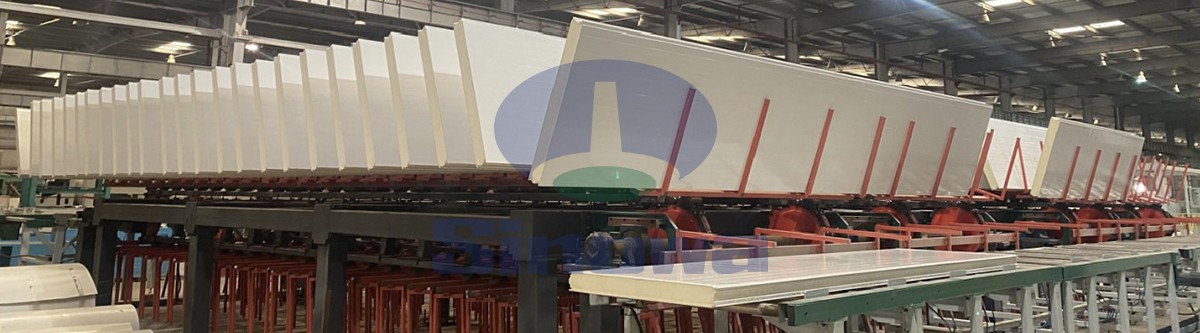
Sinowa is a well-known PU Sandwich Panel Machine Supplier From China, Dedicated to the research and development of high-end & high-efficiency pu sandwich panel machine, Sinowa is comprehensively taking the leading position in terms of efficiency, automation control level, HMI, environment protection and energy consumption, with subversive designs made in some critical technological fields to procure exceptional cost performance and customer-friendly experience for the entire pu sandwich panel machine.
The adoption of system integration technology and bus control technology accomplishes the full automatization of integrated and coordinated control of the entire pu sandwich panel machine with accessible remote interactive communication. Ranking the first-class level in the world, it is currently the continuous pu sandwich panel line in the market taking a comprehensive lead in high performance.

Based on the continuous technological pursuit, the pu sandwich panel machine developed by Sinowa provides you with high-efficiency industrial value. Based on China's cost advantage and our hard-working technology concept, our sandwich panel production line has a world-leading price-performance advantage. PU Sandwich Panel Machine can meet a variety of production needs of customers.The whole sandwich panel line design concept of modularization enables all our components to be integrated and combined at will.
Our pu sandwich panel machine can easily automate the production of roof sandwich panel, wall sandwich panel, cold storage sandwich panel and other products by different combination and configuration selection and siple switching. The inner core layer can be polyrethane or rock wool, glass wool, an so on.

The pu sandwich panel machine has high adaptability, which may produce various sandwich panel of the PU, PIR and rock wool systems.
We may design various products according to the customer’s requirements, including various configurations, so as to meet their demands with flexible price system.
Highly integrated and linked control system centralizes all control points at the main central center, achieving parameter linkage, fault self-diagnosis controlled by the whole continuous sandwich panel line and shipping distance control.
High-level automatic control system also saves the manpower and reduces the manpower loss for customers.

Concentrated system control is fully realized in the practice of concentrated process control so that the control system of all the movements of the parts in the pu sandwich panel machine is integrated in one process control console with accessible remote communication to elevate the automation and reduce the allocated number of personnel for the assembly line.
The main engine with modularized design achieves the precision operation of the pu sandwich panel machine, stable and reliable quality, less part and maintenance loss.

The whole pu sandwich panel machine is strictly modularized in design to ensure the greatest probability for the parts to be interchangeable, making it the most cost- and energy-saving. No joining made manually, all the key processes of the parts are completed in the machining center. As soon as the parts are inspected and warehoused, they enter into the assembly process. The modularized assembly can not only greatly increase the production efficiency but, most importantly, realize quick delivery as well. It elevates the reliability of product quality to a totally new level and minimizes the influence from human factors.
The whole pu sandwich panel machine has over 40 innovative inventions, making our products have lots of unique features and the comprehensive performance of our production line leading in the industry.

The precision servo hoisting mechanism employed by the main engine without hydraulic system makes the board thickness control flexible and the customer may conveniently change or adjust the board thickness. There will be not such troubles as hydraulic system adjustment, leakage, maintenance, etc.
High-level energy saving and protection design makes the whole pu sandwich panel machine possible to produce around the clock throughout the year and the customer will save huge budget. In addition, the isolated heat preservation room is constructed for warming the environment. The energy saving and protection design of our high-tech pu sandwich panel machine may guarantee that the customer’s production line may be freely heated and produce in the main time to save more costs for customers.

The high-power low-consumption design quickens the reaction of the pu sandwich panel machine while energy consumption is kept low.
With the brand-new, fully sealed inner insulation design, the energy consumption is controlled at the minimum level to achieve the design objective of less than an hour for the insulation system to be activated from the room temperature above 5℃ to the production process temperature.
The energy consumption is only 40% that of those similar products.
| PRODUCTION TYPE | PU | PIR | PHENOLIC | |||
|---|---|---|---|---|---|---|
| PRODUCTION USE | INSULATION PANEL | DOCORATIVE PANEL | ||||
| SURFACE OF SHEET | ALUMINUM FOIL | NON-WOVEN FABRIC | PAPER | NAKED | ||
| PRODUCT THICKNESS | 10m--- 200mm | |||||
| PRODUCTION SPEED | 3.0m---25m |
|---|---|
| FOAMING METHOD | TWO OR MULTI COMPONENTS FOAMING |
| FOAMING AGENT | PENTANE OR 141B |
| LENGTH OF LINE | 45m—100m CUSTOMER OPTIONAL |
Sinowa is a well-known manufacturer and technical service provider of high-end polyurethane insulation board production lines and various high-performance cold roll forming machine in China. Our main products include polyurethane double-sided color steel sandwich panel production line, polyurethane and phenolic soft facing insulation panel production line and high-efficiency roll forming machines.
Sinowa has invested outstanding efforts in both the insulation board production line and the roll forming line, This is why our products are more efficiency, quality, automatic control technology, environmental protection, energy consumption indicators and the appearance and safety protection are comprehensively leading, Some subversive design changes in many major technical points,these major innovations make our products excellent in price/performance and user experience.
Sinowa is committed to the development and manufacturing of high-end and high-efficiency sandwich panel production lines. Our sandwich panel production lines are leading the way in efficiency, automatic control, human-computer interaction, environmental protection and energy consumption. Using system integration and bus control technology, it realizes the automatic integrated linkage control of the entire production line, and can achieve remote interactive communication, which has the world-class level and a comprehensive leading high-performance production line in the market.
Against the backdrop of global energy conservation initiatives and the booming development of prefabricated construction, insulated composite building materials have become indispensable core components in modern infrastructure, cold chain logistics and industrial building fields. PU sandwich panels, featuring outstanding thermal insulation performance, lightweight structural advantages, excellent fire resistance and convenient installation characteristics, have gradually replaced traditional building insulation materials in cross-border engineering projects, factory construction, cold storage construction and refrigerated transportation industries. As the core production equipment for manufacturing such composite panels, PU sandwich panel machines determine the overall production efficiency, finished product stability, material utilization rate and comprehensive performance of final sandwich panels. Correspondingly, PU sandwich panel machine manufacturers have evolved from simple mechanical processing workshops in the early stage into comprehensive engineering solution providers integrating mechanical design, automatic control system development, chemical foaming technology matching and after-sales engineering service, playing a pivotal role in the upstream supply chain of the global prefabricated building and insulation material industry. The overall development level of machine manufacturers directly restricts the upgrading speed of the entire sandwich panel manufacturing industry and affects the popularization efficiency of energy-saving building materials worldwide.

The prosperity of the global downstream application market lays a solid demand foundation for the long-term development of PU sandwich panel machine manufacturers. In recent years, all regions of the world have accelerated the upgrading of building energy-saving standards, requiring new industrial plants, public buildings and cold storage facilities to reduce overall energy consumption through high-efficiency insulation structures. Traditional single-layer metal plates and ordinary insulation boards cannot meet the dual requirements of structural bearing capacity and long-term thermal insulation, which drives a sharp increase in market demand for high-performance PU sandwich panels. Meanwhile, the rapid expansion of global cold chain logistics networks driven by cross-border e-commerce and fresh food transportation has further boosted the demand for insulated panels used in refrigerated carriages and portable cold storage rooms. As downstream panel production enterprises expand production scales and upgrade product lines continuously, they put forward higher requirements for automation degree, production continuity, operational stability and multi-scene adaptation capabilities of supporting production machines. This continuous market demand forces PU sandwich panel machine manufacturers to carry out iterative technological upgrades, optimize overall line structure, and improve the matching degree between mechanical equipment and different production scenarios, instead of staying in the stage of producing single-function and low-automation mechanical equipment. In addition, the popularization of modular prefabricated buildings worldwide also brings new market increments, because standardized sandwich panels produced by automated production lines are the core assembled components of modular buildings, further expanding the market development space for professional machine manufacturers.
To understand the core competitiveness of PU sandwich panel machine manufacturers, it is necessary to analyze the overall structural composition and working logic of complete production lines, as well as the core technical difficulties that manufacturers need to break through in the production and research and development process. A complete PU sandwich panel production line is a highly integrated electromechanical integration system that combines mechanical transmission, hydraulic pressure, pneumatic control, automatic electrical control and polyurethane chemical foaming technology, and the whole line operates in a synchronous and coordinated manner without manual intervention in the formal production process. The entire production workflow starts with the raw material unwinding and pretreatment link. Metal surface materials stored in coil shapes are unwound stably through automatic unwinding devices, and then pass through multi-group leveling and cleaning structures to eliminate surface wrinkles, oxide layers and residual impurities, ensuring that the surface of the panel outer layer keeps flat and clean, which is a key prerequisite for firm bonding between metal surface layer and PU foam core material in subsequent processes. After pretreatment, metal sheets enter the roll forming system, where continuous rolling and bending processes shape flat metal sheets into customized plate profiles matching actual engineering needs. The precision of roll forming molds and the synchronization accuracy of rolling speed are core mechanical indicators tested by manufacturers, and subtle dimensional errors in this link will be amplified in subsequent continuous production, resulting in unqualified finished panel sizes.
The foaming and laminating section is the most technically critical part of the entire production line, and also the core technical barrier that distinguishes high-end manufacturers from ordinary mechanical processing enterprises. After the bottom metal sheet is shaped and conveyed stably, the high-pressure foaming and mixing system evenly sprays quantitatively mixed polyurethane raw materials on the surface of the bottom sheet. Polyurethane raw materials will undergo rapid chemical reaction, volume expansion and automatic foaming within a fixed temperature range. Professional manufacturers need to independently develop adaptive temperature control systems and reciprocating spraying systems to ensure uniform foam distribution without hollow holes or density differences in the core layer. Then the upper metal sheet is covered synchronously, and the composite plate structure consisting of upper and lower metal sheets and intermediate PU foam core enters the double-belt laminating and curing system. The laminating system maintains constant pressure and stable temperature to limit excessive expansion of foam materials, control the overall thickness of sandwich panels accurately, and promote complete curing and tight bonding between foam core and metal surface layers. Manufacturers need to conduct long-term process debugging to match the line running speed, foaming reaction speed and curing temperature perfectly; mismatched parameters will lead to insufficient bonding strength between core material and surface layer, delamination of finished panels, or unqualified overall thermal insulation performance. The final links include automatic fixed-length cutting, cooling shaping and intelligent stacking. The integrated post-processing system realizes automatic cutting according to customized length requirements, natural cooling of newly produced panels to stabilize internal structural stress, and automatic stacking and arrangement of finished products, realizing full-process unmanned production from raw material input to finished product output.
Global PU sandwich panel machine manufacturers can be divided into three differentiated echelons according to technical research and development capabilities, production line automation level and global market service coverage, forming a clear market competition pattern. The first echelon manufacturers focus on high-end full-continuous intelligent production lines, and devote long-term research and development resources to digital intelligent transformation of production equipment. Such manufacturers integrate industrial Internet monitoring modules into complete production lines, realizing real-time remote monitoring of operating parameters such as line running speed, foaming raw material ratio, internal curing temperature and laminating pressure. Operation staff can adjust all production parameters through a centralized human-machine interaction terminal without on-site mechanical debugging, and the system can automatically alarm and adjust parameters independently when minor parameter deviations occur, greatly reducing manual operation errors and production failure rates. Their equipment is mainly oriented to large-scale panel manufacturing enterprises with high daily output requirements, suitable for long-term uninterrupted continuous production, and can adapt to diversified production demands of multi-specification and multi-profile panels by replacing simple molds. Meanwhile, these manufacturers focus on overall energy consumption optimization of production lines, reducing power consumption and raw material waste in the production process to help downstream users lower long-term operating costs.
The second echelon manufacturers occupy the mainstream middle-end market, balancing equipment manufacturing cost and automation performance to provide cost-effective semi-continuous production lines that meet most medium-sized panel manufacturers’ production needs. Different from full-continuous high-end equipment, semi-continuous production lines adopt segmented synchronous control systems, which have slightly lower operating speed than full-continuous lines but have stronger flexibility in production switching. Such equipment can quickly switch between different thickness specifications and panel types without long-term line shutdown and parameter debugging, which is very suitable for medium-sized manufacturing enterprises with diversified order types and unstable single-batch order volume. These manufacturers do not pursue fully unmanned production, but optimize core foaming and laminating structures to ensure stable finished panel quality, and match mature and easy-to-maintain electrical control systems to reduce later maintenance difficulty and maintenance cost for users. They occupy the largest market share in global emerging economies, meeting the basic equipment renewal and capacity expansion needs of most local sandwich panel producers.
The third echelon is small-scale mechanical processing manufacturers focusing on low-end discontinuous production equipment. Such enterprises lack independent research and development capabilities of core control systems and foaming process matching technologies, mostly adopting mature public technical schemes for assembly production of mechanical structures. Their equipment has low automation degree, requiring more manual participation in material feeding, foaming injection and plate taking processes, with relatively limited daily production capacity. Nevertheless, such equipment has low overall procurement cost and simple operation logic, which is very suitable for small startup panel factories with limited initial investment and small daily order volume in remote areas and underdeveloped regions. The existence of differentiated echelons of manufacturers meets the diversified equipment procurement demands of downstream users with different scales, different capital budgets and different production modes, forming a complete and orderly global equipment supply system.
In the process of global market layout, PU sandwich panel machine manufacturers also face multiple practical industry challenges restricting their long-term development, including technical iteration pressure, raw material cost fluctuation, cross-region adaptation difficulties and after-sales service layout barriers. Firstly, with the continuous update of global building energy-saving standards and fire protection requirements, the formula of polyurethane foam core materials is constantly upgraded, and higher requirements are put forward for foaming pressure, temperature matching and injection accuracy of supporting machines. Manufacturers need to continuously upgrade foaming systems and control programs synchronously with material iteration, otherwise old-generation production lines will be eliminated by the market quickly. Secondly, fluctuation of steel prices and hydraulic component prices affects the overall production cost of mechanical equipment all year round. Manufacturers need to optimize mechanical structure design, reduce unnecessary material use while ensuring equipment structural strength, and stabilize equipment quotation and profit space through lean production management.
Cross-regional production adaptation is another prominent difficulty for global machine manufacturers. Different regions have different mainstream panel specifications, local climatic conditions affect the foaming reaction efficiency of polyurethane raw materials, and power supply parameters also have obvious differences across countries and regions. A production line that operates stably in temperate regions may have unstable foaming effects in high-temperature tropical areas or low-temperature frigid zones due to ambient temperature interference. Therefore, excellent manufacturers need to carry out targeted regional parameter optimization for exported equipment according to local environmental characteristics, rather than adopting unified equipment parameters for global sales. In addition, complete PU sandwich panel production lines belong to large-scale electromechanical integrated equipment with complex internal structures. Once mechanical failure or control system failure occurs in the later operation process, long-distance after-sales maintenance cannot solve problems efficiently. Therefore, manufacturers need to build localized after-sales service teams and spare parts warehouses in key overseas markets, increasing the long-term operating cost and operation difficulty of enterprises.
In recent years, mainstream PU sandwich panel machine manufacturers have begun to transform from single equipment suppliers to overall production solution providers, which has become a clear industrial development trend. In the past, manufacturers only provided complete production lines and simple equipment operation manuals after completing equipment delivery. Now leading manufacturers will provide one-stop supporting services including pre-production plant layout design, production line flow planning, staff operation training, raw material matching process debugging and long-term regular equipment maintenance according to users’ actual plant area, target panel types and daily production capacity demands. This integrated service mode can help downstream panel manufacturers shorten the equipment commissioning cycle, quickly reach standard production capacity after equipment installation, and avoid production losses caused by improper operation and parameter debugging errors. Meanwhile, manufacturers also carry out joint technical research with polyurethane raw material suppliers and downstream panel production enterprises to jointly optimize the matching relationship between mechanical equipment, chemical raw materials and production processes, further improving finished panel quality and overall production efficiency.
Intelligent manufacturing and green low-carbon production will be the core two major development directions for PU sandwich panel machine manufacturers in the next five to ten years. In terms of intelligent upgrading, more artificial intelligence visual detection modules will be added to production lines in the future, realizing automatic real-time detection of panel surface defects, core layer foaming uniformity and bonding tightness during the production process. Unqualified products will be automatically marked and separated without manual quality inspection, further reducing labor costs and improving product qualification rate. Meanwhile, cloud platform remote diagnosis technology will be widely applied; manufacturers can remotely view equipment operating data, judge potential mechanical faults in advance and carry out predictive maintenance without on-site inspection, greatly reducing equipment downtime. In terms of green and low-carbon upgrading, manufacturers will focus on optimizing the energy-saving design of heating curing systems and driving motors of production lines to reduce overall power consumption of equipment. Besides, new generation equipment will support the production of panels with low-carbon and environment-friendly polyurethane raw materials, adapt to the global carbon neutrality development goal, and help downstream building material production industries reduce overall carbon emission in the whole production chain.
In conclusion, PU sandwich panel machine manufacturers are important connecting links connecting upstream polyurethane chemical raw material industry and downstream prefabricated building, cold chain logistics and transportation industries. From traditional simple mechanical equipment assembly to current intelligent electromechanical integrated production lines, and from single equipment sales to overall industrial solution services, the continuous upgrading of manufacturers’ technology and service modes has promoted the overall progress of the global sandwich panel industry. Facing stricter global energy-saving policies, increasingly fierce market competition and growing personalized customized production demands of downstream customers, manufacturers must continue to take independent technological research and development as the core, accelerate intelligent and green iterative upgrading of equipment, improve cross-regional adaptive capacity and localized service systems. In the future, with the further popularization of prefabricated buildings and the continuous expansion of global cold chain infrastructure construction, high-quality PU sandwich panel machine manufacturers with core independent technologies and perfect global service layout will gain broader market development opportunities, and continuously promote the high-quality and low-carbon development of the entire energy-saving building material manufacturing industry.
«PU Sandwich Panel Machine Manufacturers» Update Date:2026/6/15
URL: https://www.sinowa.cn/en/blog/pu-sandwich-panel-machine-manufacturers.html
Tags: Continuous PU Sandwich Panel Machine , PU Sandwich Panel Machine ,