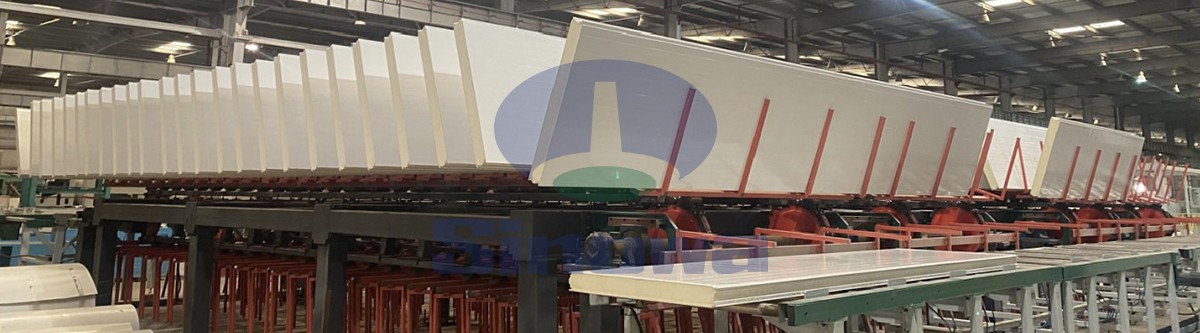
Sinowa is a well-known PU Sandwich Panel Processing Line Supplier From China, Dedicated to the research and development of high-end & high-efficiency pu sandwich panel line, Sinowa is comprehensively taking the leading position in terms of efficiency, automation control level, HMI, environment protection and energy consumption, with subversive designs made in some critical technological fields to procure exceptional cost performance and customer-friendly experience for the entire pu sandwich panel line.
The adoption of system integration technology and bus control technology accomplishes the full automatization of integrated and coordinated control of the entire pu sandwich panel line with accessible remote interactive communication. Ranking the first-class level in the world, it is currently the continuous pu sandwich panel line in the market taking a comprehensive lead in high performance.

Based on the continuous technological pursuit, the pu sandwich panel line developed by Sinowa provides you with high-efficiency industrial value. Based on China's cost advantage and our hard-working technology concept, our sandwich panel production line has a world-leading price-performance advantage. PU Sandwich Panel Line can meet a variety of production needs of customers.The whole sandwich panel line design concept of modularization enables all our components to be integrated and combined at will.
Our pu sandwich panel line can easily automate the production of roof sandwich panel, wall sandwich panel, cold storage sandwich panel and other products by different combination and configuration selection and siple switching. The inner core layer can be polyrethane or rock wool, glass wool, an so on.

The pu sandwich panel line has high adaptability, which may produce various sandwich panel of the PU, PIR and rock wool systems.
We may design various products according to the customer’s requirements, including various configurations, so as to meet their demands with flexible price system.
Highly integrated and linked control system centralizes all control points at the main central center, achieving parameter linkage, fault self-diagnosis controlled by the whole continuous sandwich panel line and shipping distance control.
High-level automatic control system also saves the manpower and reduces the manpower loss for customers.

Concentrated system control is fully realized in the practice of concentrated process control so that the control system of all the movements of the parts in the pu sandwich panel line is integrated in one process control console with accessible remote communication to elevate the automation and reduce the allocated number of personnel for the assembly line.
The main engine with modularized design achieves the precision operation of the pu sandwich panel line, stable and reliable quality, less part and maintenance loss.

The whole pu sandwich panel line is strictly modularized in design to ensure the greatest probability for the parts to be interchangeable, making it the most cost- and energy-saving. No joining made manually, all the key processes of the parts are completed in the machining center. As soon as the parts are inspected and warehoused, they enter into the assembly process. The modularized assembly can not only greatly increase the production efficiency but, most importantly, realize quick delivery as well. It elevates the reliability of product quality to a totally new level and minimizes the influence from human factors.
The whole pu sandwich panel line has over 40 innovative inventions, making our products have lots of unique features and the comprehensive performance of our production line leading in the industry.

The precision servo hoisting mechanism employed by the main engine without hydraulic system makes the board thickness control flexible and the customer may conveniently change or adjust the board thickness. There will be not such troubles as hydraulic system adjustment, leakage, maintenance, etc.
High-level energy saving and protection design makes the whole pu sandwich panel line possible to produce around the clock throughout the year and the customer will save huge budget. In addition, the isolated heat preservation room is constructed for warming the environment. The energy saving and protection design of our high-tech pu sandwich panel line may guarantee that the customer’s production line may be freely heated and produce in the main time to save more costs for customers.

The high-power low-consumption design quickens the reaction of the pu sandwich panel line while energy consumption is kept low.
With the brand-new, fully sealed inner insulation design, the energy consumption is controlled at the minimum level to achieve the design objective of less than an hour for the insulation system to be activated from the room temperature above 5℃ to the production process temperature.
The energy consumption is only 40% that of those similar products.
| PRODUCTION TYPE | PU | PIR | PHENOLIC | |||
|---|---|---|---|---|---|---|
| PRODUCTION USE | INSULATION PANEL | DOCORATIVE PANEL | ||||
| SURFACE OF SHEET | ALUMINUM FOIL | NON-WOVEN FABRIC | PAPER | NAKED | ||
| PRODUCT THICKNESS | 10m--- 200mm | |||||
| PRODUCTION SPEED | 3.0m---25m |
|---|---|
| FOAMING METHOD | TWO OR MULTI COMPONENTS FOAMING |
| FOAMING AGENT | PENTANE OR 141B |
| LENGTH OF LINE | 45m—100m CUSTOMER OPTIONAL |
Sinowa is a well-known manufacturer and technical service provider of high-end polyurethane insulation board production lines and various high-performance cold roll forming machine in China. Our main products include polyurethane double-sided color steel sandwich panel production line, polyurethane and phenolic soft facing insulation panel production line and high-efficiency roll forming machines.
Sinowa has invested outstanding efforts in pu sandwich panel processing line, This is why our products are more efficiency, quality, automatic control technology, environmental protection, energy consumption indicators and the appearance and safety protection are comprehensively leading, Some subversive design changes in many major technical points,these major innovations make our products excellent in price/performance and user experience.
Sinowa is committed to the development and manufacturing of high-end and high-efficiency pu sandwich panel processing line. Our sandwich panel production lines are leading the way in efficiency, automatic control, human-computer interaction, environmental protection and energy consumption. Using system integration and bus control technology, it realizes the automatic integrated linkage control of the entire production line, and can achieve remote interactive communication, which has the world-class level and a comprehensive leading high-performance production line in the market.
Polyurethane sandwich panels have become one of the most widely used building envelope materials in modern construction, valued for their outstanding thermal insulation, lightweight strength, and fast installation. A PU sandwich panel processing line is the integrated manufacturing system that turns raw chemicals and metal coils into finished panels with consistent quality and high output. This article explains how such a line works, what stages it includes, and why its design matters to both product performance and operational efficiency.
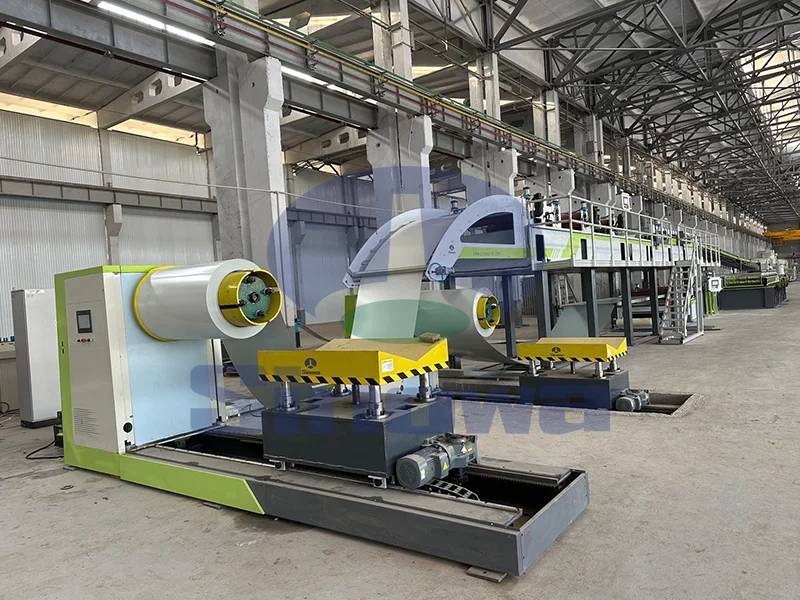
The foundation of every PU sandwich panel line begins with the raw material handling and coil feeding section. Two metal coils—typically galvanized steel, aluminum, or pre-painted steel—are loaded onto decoilers that rotate to release the sheet at a controlled tension. Automatic or manual splicing stations connect the end of one coil to the start of the next, allowing continuous production without stopping the line. The metal sheets then pass through a series of roll-forming stations where they are gradually shaped into the desired profile, whether that means flat surfaces, corrugated faces, or the subtle ribs that give panels their structural stiffness. Precision guides and edge rollers ensure that both top and bottom skins stay perfectly aligned, because even a minor offset at this stage can cause defects that appear only after the foam has been injected and cured. The decoiler and roll-former must work in sync with the rest of the line, adjusting speed instantly whenever the downstream cutter or laminator changes pace, and modern servo-controlled systems make this synchronization remarkably smooth.
Once the metal skins have been formed, they enter the double belt laminator, which is the heart of the entire PU panel line. The top and bottom sheets travel parallel to each other through a long, heated press where the polyurethane foam is injected between them. A high-pressure mixing head dispenses precise amounts of polyol, isocyanate, blowing agent, and catalyst onto the moving bottom skin, distributing the chemical mixture evenly across the width. As the belt carries the assembly forward, the foam expands chemically, fills every corner of the cavity, and bonds firmly to both metal faces. The steel belt itself is heated and often water-cooled at the exit, controlling the reaction temperature so that the foam cures uniformly without scorching or incomplete expansion. The length of the laminator determines how much dwell time the foam needs to reach sufficient green strength before the panel exits; longer lines allow faster belt speeds and higher output, but they also demand more precise temperature profiling to avoid wasting energy.
Chemical preparation and dosing represent the unseen engineering that determines foam quality. PU foam is produced by reacting two main liquid components: a polyol blend and an isocyanate, usually MDI. These are stored in temperature-controlled tanks, often agitated to prevent settling of additives and wrapped with heating or cooling jackets to keep viscosity stable. High-pressure metering pumps draw the chemicals through insulated lines and deliver them at precisely regulated ratios to the mixing head. Even a one-percent deviation in the polyol-to-isocyanate ratio can ruin the foam, causing brittle cells, poor adhesion, or inconsistent insulation values. The blowing agent, whether a physical gas or a water-based chemical system, is injected separately and must be mixed in at the exact moment the foam is deposited. Operators monitor flow rates, tank pressures, and temperatures through a central control panel, and recipes are stored digitally so that switching between panel thicknesses or densities takes only minutes rather than hours. This closed-loop dosing is what allows a single line to produce panels ranging from thin interior partitions to thick freezer-room walls without changing hardware.
As the foam sandwich exits the laminator, it is still a continuous ribbon many meters long, and the next challenge is cutting it to exact lengths without damaging the delicate skin or distorting the fresh foam. A flying saw or pendulum cutter moves in lockstep with the moving panel, sawing through both metal faces and the PU core while the line keeps running. Because the panel is hot and slightly soft at this point, the blade must be sharp, cooled, and guided accurately; a wandering cut produces mismatched edges that prevent panels from fitting together on site. After the cut, the panel passes through a discharge conveyor where it is flipped or stacked by an automatic manipulator. Some lines include notching or end-machining stations that create the joint profiles—tongue-and-groove, hidden-fastener, or shiplap edges—that allow panels to interlock when installed. The cutting and handling section must be robust, because a production line can easily produce several hundred panels per shift, and manual stacking would introduce both labor cost and risk of surface scratches.
Quality control in a PU panel line operates at several levels, from in-line sensors to end-of-line inspection. Thickness gauges mounted near the laminator exit measure the panel's height continuously and feed that data back to the dosing system, automatically adjusting foam output if the panel drifts outside tolerance. Weight checkers compare each finished panel against the target density, because foam density directly determines both insulation performance and structural strength. Visual inspection cameras can detect dents, coating scratches, or misprinted decorative films before the panel reaches the customer. Thermal imaging may spot uneven curing that would otherwise remain hidden until the panel is installed. Good lines also include sample-testing stations where operators periodically cut a cross-section and inspect cell structure, skin adhesion, and edge fill. The goal is not to catch defects after the fact, but to close the loop so that minor process drift is corrected before dozens of panels are wasted. A well-instrumented line therefore becomes a data source as much as a production machine.
Energy and environmental considerations increasingly shape how modern PU lines are designed. Polyurethane chemistry is exothermic, but the laminator still needs external heat to control expansion and cure, and heating large steel belts consumes significant power. Heat recovery systems capture warm air from the cooling zone and reuse it to pre-heat the laminator, reducing gas or electricity demand. The blowing agent itself has a direct environmental footprint, and manufacturers have moved from older high-GWP gases toward lower-impact alternatives that require modified dosing equipment and better sealing around the foaming zone. Fume extraction systems remove isocyanate vapors and solvent fumes from the mixing area, protecting workers and preventing odor buildup in the finished panels. Water-based cleaning of the mixing head, rather than solvent flushing, reduces waste stream volume. Even the metal scrap from trimming edges is collected, baled, and recycled. These choices do not just satisfy regulation; they lower operating cost and give building owners a product whose embodied environmental impact is acceptable for green-building certifications.
Line layout and automation determine how efficiently a factory can run, and they interact closely with the building footprint. A typical PU panel line is a long, straight machine, often 50 to 80 meters from decoiler to discharge, and it demands a floor with flat tolerance sufficient for precise belt tracking. Raw material storage must sit near the decoilers so that coil changes are quick, while the finished-panel stacking and packing area needs room for forklift movement and outbound trucks. Modern lines are controlled by a programmable logic controller linked to a manufacturing execution system, which logs every panel's production parameters, operator shift, and material batch. This traceability is invaluable when a customer reports a defect: engineers can look up the exact foam recipe, belt temperature, and cutter speed for that specific panel and identify whether the issue came from chemicals, metal coil, or process drift. Human-machine interfaces on the shop floor let operators override speeds, call up recipes, and diagnose alarms, while remote-access modules allow equipment makers to troubleshoot without traveling to the site. The result is a production system that is less like a single machine and more like a coordinated plant.
Maintenance, safety, and workforce skills are often the deciding factors between a line that performs as advertised and one that underdelivers. High-pressure mixing heads need regular seal replacement and rigorous flushing after every run; residual foam left inside will destroy the next batch. The steel belts on the laminator are precision-ground and must be inspected for scratches that would transfer onto the panel skin. Roll-forming stations wear gradually, and operators must watch profile dimensions as tooling ages. Safety interlocks around the moving belt, emergency stops at every operator station, and guarding on flying saws are non-negotiable because the line combines moving metal, hot surfaces, and reactive chemicals. Training programs for operators cover chemical handling, pump calibration, and defect diagnosis, because a skilled crew can keep the line running at optimal speed with minimal scrap. Predictive maintenance schedules, based on pump run hours and belt vibration data, replace old "break-fix" habits. Over time, the difference between a profitable panel factory and a struggling one comes down not to the headline specifications of the line, but to how well it is cared for and operated.
Looking ahead, PU sandwich panel lines continue to evolve in response to changing building demands. Thicker, higher-insulation panels reduce energy loss in cold-climate construction, while lighter facings suit modular and prefabricated buildings where weight affects transport and lifting demand. Decorative laminated films and stone- or wood-printed finishes turn panels from a utility product into an aesthetic surface, pushing lines to integrate film-unwind and lamination stations alongside the metal skins. Digital twins and simulation software let engineers test new panel profiles or foam recipes virtually before committing physical tooling. Robotics are taking over stacking, strapping, and loading, reducing labor dependence and improving packaging consistency. Yet the core process—coil forming, foam injection, belt lamination, and precision cutting—remains the backbone. For builders, designers, and factory owners, understanding how a PU sandwich panel line works is the first step toward choosing the right product, running an efficient plant, and ensuring that the walls and roofs being built today will perform reliably for decades.
«PU Sandwich Panel Processing Line» Update Date:2026/10/13
URL: https://www.sinowa.cn/en/blog/pu-sandwich-panel-processing-line.html
Tags: PU Sandwich Panel Lines , Continuous PU Sandwich Panel Line ,