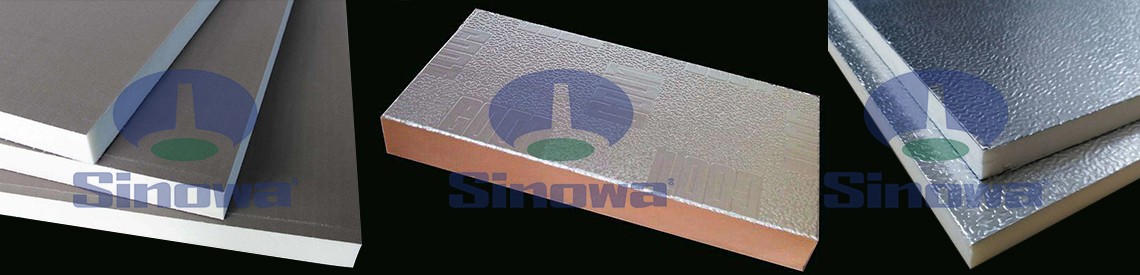
Sinowa is a well-known Insulation Foam PU Sandwich Panel Lines Supplier From China, Continuous Insulation Panel Production Line of the PU and phenolic aldehyde surface has diversified and multifunctional production characteristics, which may produce products with different specifications such as PU, PF, PIR, etc.
The surface material may be aluminum foil, colored steel, cement base cloth, kraft paper, non-woven fabrics, etc.
The products are widely applied to such occasions as construction, decoration, pipeline ventilation, subway construction, etc.

The pu sandwich panel line of soft layer insulation board is able to continuously and efficiently produce high-quality PU and Phenolic insulation boards.
We spare no efforts to improve our product quality and technological reliability by employing the most cutting-edge and the most reliable support and processes to make our products highly reliable and endurable. As a result, the pu sandwich panel line of our soft layer insulation panels is highlighted by many perfect qualities. It is the core idea in Sinowa's product roadmap to surpass our competitors in terms of design philosophy, manufacture methods and service level, going for excellence and leading position and making constant improvement on our products and services, which is also our core value system to create efficiency and convenience for our customers.

Well-grounded on our solid strength as a renowned large-scale enterprise, Sinowa has a high starting point in developing industrial assembly lines.
Based on the advanced science and technology introduced from within and without the country and supported by a great number of first-grade parts and components from the home and aboard, these assembly lines have a high-level configuration of supporting products in terms of machinery, electrical control, hydraulic pressure, automatic measurement and tracking, and so on.
This is a strong proof of our product’s reliable quality and high efficiency.

The first-class appearance design and excellent energy saving measures make it unnecessary for customers to additionally construct the heat preservation and isolation room for production around the clock throughout the year, so that the customers may save lots of resources and costs.
Modularized standard design and important parts machined with CNC machine tool make the production line have excellent quality assurance. Dependence on the man-made factors is eliminated. The operation is precision, with the highest operation speed of 30m/min. The pu sandwich panel line has the world-class production efficiency.

The high performance and reliable multicomponent cyclopentane foaming technology and equipment of Sinowa may be also applied to the foaming process of the phenolic aldehyde board. Therefore, our customers may not only freely adjust the foaming matching according to the raw material, but also save lots of costs. Moreover, they are of significance for environmental protection.
Sinowa's industrial pu sandwich panel line of insulation panels is distinguished by its impressive performance of energy conservation. In each high point of energy consumption throughout the entire pu sandwich panel line are implemented corresponding measures to considerably lower the consumption level.

For example, the body of the lamination belt conveyer is covered with insulation panels in very reasonable structures, which doesn’t blemish the overall outlook but greatly increases the insulation performance.
The entire pu sandwich panel line is constantly optimized and improved so that the consumption of each power source is significantly reduced. The motor power of our lamination conveying system is only 3.0 kw, about 50% less than those of the same kind.
All in all, the energy consumption of the whole sandwich panel line equals 40% or even less of the equivalent lines in the market.

The pu sandwich panel line of Sinowa adopts the most advanced concepts in the world to realize the modularized design with all the parts bolted together rather than welded.
In standardized production, the parts can be dismantled and exchanged, so the production cycle is drastically shortened and the maintenance becomes by far easier.
Through finite element analysis, the equipment design is greatly optimized to realize modularization, digitization, and weight-minimalization.
| PRODUCTION TYPE | PU | PIR | PHENOLIC | |||
|---|---|---|---|---|---|---|
| PRODUCTION USE | INSULATION PANEL | DOCORATIVE PANEL | ||||
| SURFACE OF SHEET | ALUMINUM FOIL | NON-WOVEN FABRIC | PAPER | NAKED | ||
| PRODUCT THICKNESS | 10m--- 200mm | |||||
| PRODUCTION SPEED | 3.0m---25m |
|---|---|
| FOAMING METHOD | TWO OR MULTI COMPONENTS FOAMING |
| FOAMING AGENT | PENTANE OR 141B |
| LENGTH OF LINE | 45m—100m CUSTOMER OPTIONAL |
Sinowa is a well-known manufacturer and technical service provider of high-end polyurethane insulation board production lines and various high-performance cold roll forming machine in China. Our main products include polyurethane double-sided color steel sandwich panel production line, polyurethane and phenolic soft facing insulation panel production line and high-efficiency roll forming machines.
Sinowa has invested outstanding efforts in insulation foam pu sandwich panel lines, This is why our products are more efficiency, quality, automatic control technology, environmental protection, energy consumption indicators and the appearance and safety protection are comprehensively leading, Some subversive design changes in many major technical points,these major innovations make our products excellent in price/performance and user experience.
Sinowa is committed to the development and manufacturing of high-end and high-efficiency insulation foam pu sandwich panel lines. Our sandwich panel production lines are leading the way in efficiency, automatic control, human-computer interaction, environmental protection and energy consumption. Using system integration and bus control technology, it realizes the automatic integrated linkage control of the entire production line, and can achieve remote interactive communication, which has the world-class level and a comprehensive leading high-performance production line in the market.
PU insulation foam sandwich panel lines represent a cornerstone of modern building envelope manufacturing, combining continuous lamination technology with precise foam chemistry to produce panels that balance structural strength, thermal efficiency, and architectural versatility. These automated production systems transform raw metal coils and chemical components into finished insulated panels used across commercial, industrial, and residential construction worldwide.
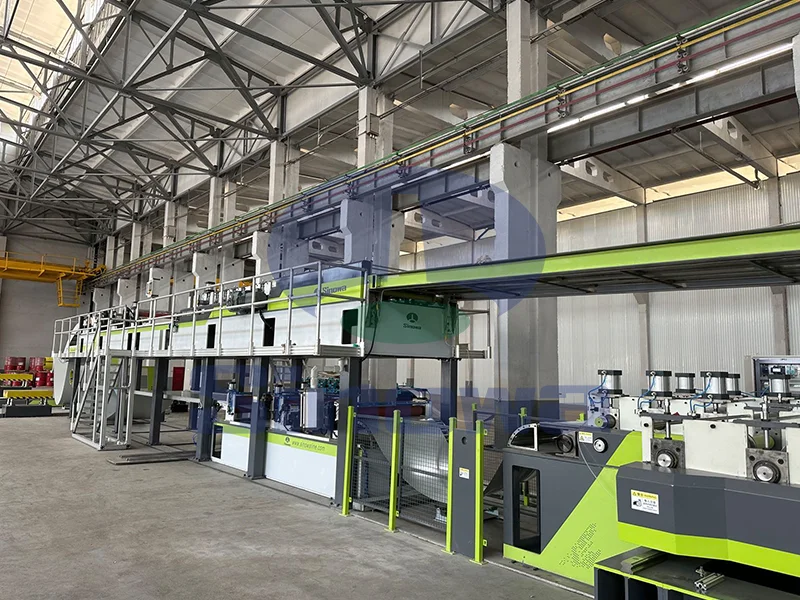
The production process begins with the uncoiling and preparation of metal facing sheets, typically galvanized steel, aluminum, or stainless steel, depending on the intended application and environmental exposure. The uncoiling station feeds the sheet through a series of leveling rollers that eliminate coil set and ensure flat, uniform surfaces before the sheet enters the preheating section. At this stage, the sheet passes through felt rollers and a preheater that brings the metal to the optimal temperature for foam adhesion. Chemical release agents are then applied to facilitate later demolding and ensure smooth, consistent surface finish. The precision of this preparation stage directly determines the bonding quality between the metal face and the foam core, making it one of the most critical control points on the entire line.
At the heart of the line sits the high-pressure foam metering and mixing system, which precisely combines polyol blend, isocyanate, blowing agent, catalysts, and other additives in exact ratios. Polyurethane chemistry requires meticulous temperature and pressure control, as even minor variations in component temperature can alter reaction kinetics, cell structure, and final foam density. The mixing head injects the reacting mixture onto the lower metal facing as it travels along the laminating conveyor. Sophisticated mixing technology ensures that the chemical streams combine homogeneously without entrapping air, producing a fine, closed-cell structure that delivers exceptional thermal resistance. Modern systems employ digital flow monitoring and closed-loop feedback that continuously adjust injection rates based on line speed, ensuring consistent panel thickness and density across the entire production run.
The double-belt laminating press is where the sandwich structure takes its final form. As the lower sheet carries the expanding foam, the upper metal facing descends from above, sandwiching the reactive material between two precisely guided steel belts. The belts maintain uniform pressure and controlled temperature along a lengthy curing tunnel, allowing the foam to rise, expand, and cure while constrained to the exact panel profile. This continuous process ensures that foam density gradients are minimized, edge compression is controlled, and both faces adhere evenly. The press length and belt speed are carefully calibrated to match the foam's cure profile—too short and the panel exits soft and deformed; too long and production throughput suffers. Heated zones within the tunnel accelerate cross-linking, while cooling zones near the exit set the foam before cutting.
Panel profile formation is handled by roll forming stations that shape the metal facings into architectural seams, corrugations, or flat configurations as required by the panel design. For wall panels, trapezoidal or ribbed profiles provide stiffness and visual interest, while roof panels often feature concealed-clip standing seam geometries. The roll formers can be interchanged or adjusted to accommodate different panel widths and profiles without full line stoppage. Some lines incorporate embossing units that apply decorative textures to the facing sheets, expanding the aesthetic possibilities for interior and exterior applications. The integration of roll forming with foam lamination requires careful synchronization, because the forming rollers must not crush or distort the partially cured foam core as the panel passes through.
Cutting and cross-section finishing occur after the panel has fully cured within the laminating tunnel. A flying saw or cutoff machine moves in sync with the moving panel, cutting it to the specified length while the line continues at full speed. This synchronized cutting eliminates shear stress on the fresh foam and produces clean, square edges. After cutting, panels travel on an output conveyor where they are inspected, stacked, and packaged for shipment. Quality checks at this stage include visual inspection for surface defects, measurement of panel thickness and flatness, and verification of overall dimensions. Some facilities incorporate automated vision systems that scan each panel for coating imperfections, delamination, or foam voids, flagging defective units before they reach the stacking station.
The versatility of PU sandwich panel lines extends beyond standard wall and roof panels. Adjustable tooling and interchangeable molds allow the same line to produce cold room panels, cleanroom panels, acoustic panels, and door cores by modifying profile shapes, density ranges, and facing specifications. Cold room applications demand denser foam cores with enhanced low-temperature performance, while cleanroom panels require seamless, easy-to-clean surfaces with precise edge details. Switching between product types involves changing roll former profiles, adjusting foam density setpoints, and modifying injection patterns—tasks that modern lines are designed to accomplish with minimal downtime. This production flexibility makes such lines valuable investments for manufacturers serving multiple market segments simultaneously.
Energy efficiency and environmental considerations increasingly shape how these lines are designed and operated. Modern foam chemistry has shifted toward lower global warming potential blowing agents, reducing the environmental footprint of the panels themselves while maintaining insulation performance. On the production side, waste heat recovery systems capture thermal energy from the laminating press and reuse it to preheat incoming metal sheets or chemical components, lowering overall energy consumption. Closed-loop chemical recycling systems capture and reuse overspray and edge trim foam scrap, minimizing material waste. Operators also monitor emissions from the foam reaction process, employing exhaust and filtration systems to manage volatile organic compounds released during cure. These sustainability measures not only reduce operating costs but also align the built products with evolving green building expectations.
Operational safety and worker ergonomy are integral to modern line design. Guarded moving parts, emergency stop circuits distributed along the entire line length, and interlocked access panels prevent operator contact with hazardous zones during production. Chemical handling stations feature enclosed dispensing systems and personal protective equipment protocols, since isocyanate components require careful handling. Human-machine interfaces place all line controls, recipe settings, and diagnostic data at the operator's fingertips, reducing the need for manual adjustment at mechanical stations. Training programs emphasize not only equipment operation but also foam chemistry fundamentals, so operators understand how temperature, speed, and ratio adjustments affect final panel quality. Preventive maintenance schedules, guided by sensors that monitor bearing wear, belt tension, and pump performance, help avoid unexpected downtime and extend equipment service life.
Looking ahead, PU sandwich panel lines continue to evolve toward greater digital integration and production intelligence. Manufacturers increasingly adopt Industry 4.0 concepts, connecting every station on the line to a central data system that tracks production parameters in real time, identifies drift before defects occur, and generates comprehensive quality records for each panel batch. Artificial intelligence algorithms analyze historical production data to optimize recipes, reduce scrap rates, and predict maintenance needs. The panels themselves are also becoming more sophisticated, with integrated vapor barriers, embedded sensor networks for structural health monitoring, and modular connection systems that speed on-site installation. As building performance requirements rise and construction methods industrialize further, the PU sandwich panel line will remain the essential bridge between raw materials and high-performance building envelopes, continuously refining how insulation, structure, and design come together.
«Insulation Foam PU Sandwich Panel Lines» Update Date:2026/10/13
URL: https://www.sinowa.cn/en/blog/insulation-foam-pu-sandwich-panel-lines.html
Tags: PU Sandwich Panel Lines , Continuous PU Sandwich Panel Line ,