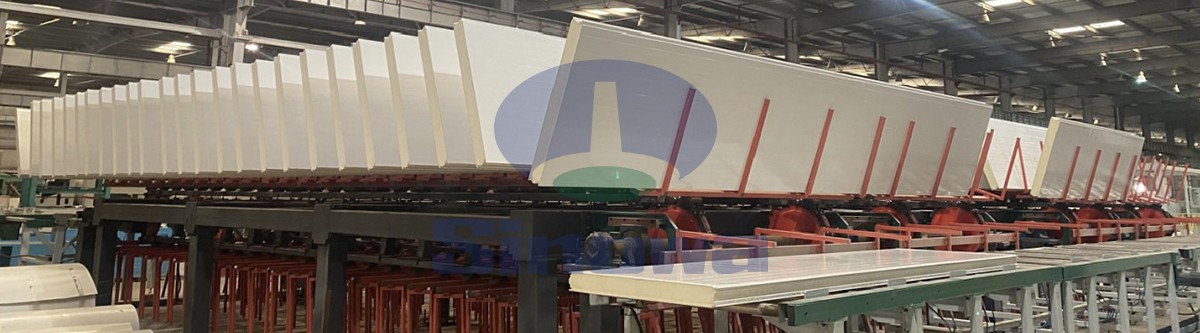
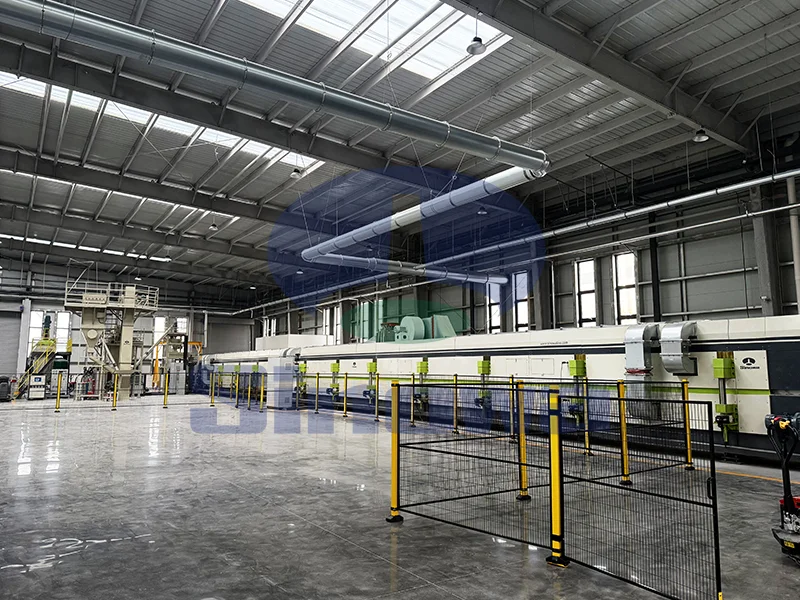
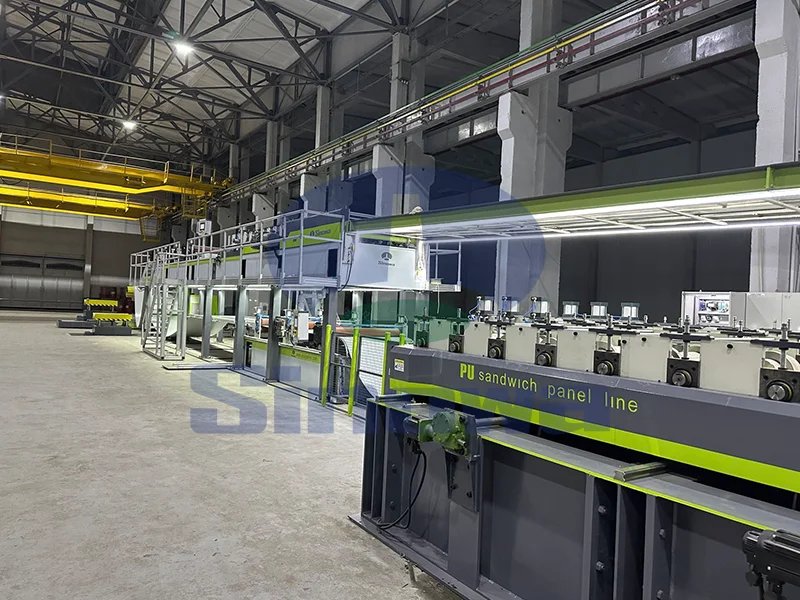
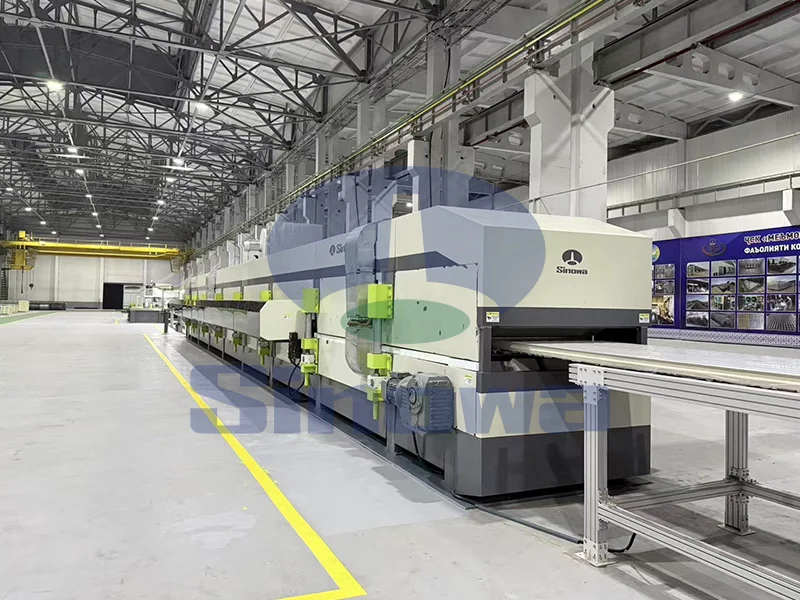
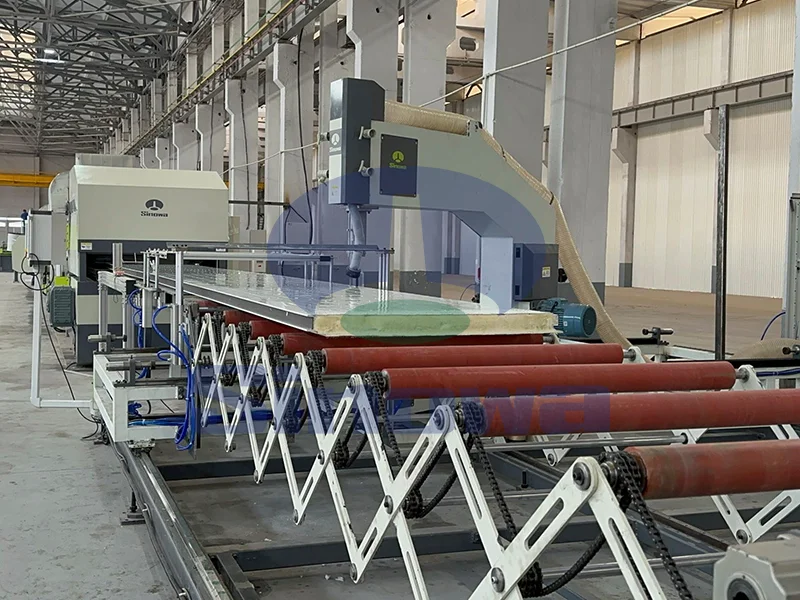
Sinowa is a well-known PIR Sandwich Panel Line Supplier From China, Dedicated to the research and development of high-end & high-efficiency pir sandwich panel line, Sinowa is comprehensively taking the leading position in terms of efficiency, automation control level, HMI, environment protection and energy consumption, with subversive designs made in some critical technological fields to procure exceptional cost performance and customer-friendly experience for the entire pir sandwich panel line.
The adoption of system integration technology and bus control technology accomplishes the full automatization of integrated and coordinated control of the entire pir sandwich panel line with accessible remote interactive communication. Ranking the first-class level in the world, it is currently the continuous pu sandwich panel line in the market taking a comprehensive lead in high performance.

Based on the continuous technological pursuit, the pir sandwich panel line developed by Sinowa provides you with high-efficiency industrial value. Based on China's cost advantage and our hard-working technology concept, our sandwich panel production line has a world-leading price-performance advantage. PIR Sandwich Panel Line can meet a variety of production needs of customers.The whole sandwich panel line design concept of modularization enables all our components to be integrated and combined at will.
Our pir sandwich panel line can easily automate the production of roof sandwich panel, wall sandwich panel, cold storage sandwich panel and other products by different combination and configuration selection and siple switching. The inner core layer can be polyrethane or rock wool, glass wool, an so on.

The pir sandwich panel line has high adaptability, which may produce various sandwich panel of the PU, PIR and rock wool systems.
We may design various products according to the customer’s requirements, including various configurations, so as to meet their demands with flexible price system.
Highly integrated and linked control system centralizes all control points at the main central center, achieving parameter linkage, fault self-diagnosis controlled by the whole continuous sandwich panel line and shipping distance control.
High-level automatic control system also saves the manpower and reduces the manpower loss for customers.

Concentrated system control is fully realized in the practice of concentrated process control so that the control system of all the movements of the parts in the pir sandwich panel line is integrated in one process control console with accessible remote communication to elevate the automation and reduce the allocated number of personnel for the assembly line.
The main engine with modularized design achieves the precision operation of the pir sandwich panel line, stable and reliable quality, less part and maintenance loss.

The whole pir sandwich panel line is strictly modularized in design to ensure the greatest probability for the parts to be interchangeable, making it the most cost- and energy-saving. No joining made manually, all the key processes of the parts are completed in the machining center. As soon as the parts are inspected and warehoused, they enter into the assembly process. The modularized assembly can not only greatly increase the production efficiency but, most importantly, realize quick delivery as well. It elevates the reliability of product quality to a totally new level and minimizes the influence from human factors.
The whole pir sandwich panel line has over 40 innovative inventions, making our products have lots of unique features and the comprehensive performance of our production line leading in the industry.

The precision servo hoisting mechanism employed by the main engine without hydraulic system makes the board thickness control flexible and the customer may conveniently change or adjust the board thickness. There will be not such troubles as hydraulic system adjustment, leakage, maintenance, etc.
High-level energy saving and protection design makes the whole pir sandwich panel line possible to produce around the clock throughout the year and the customer will save huge budget. In addition, the isolated heat preservation room is constructed for warming the environment. The energy saving and protection design of our high-tech pir sandwich panel line may guarantee that the customer’s production line may be freely heated and produce in the main time to save more costs for customers.

The high-power low-consumption design quickens the reaction of the pir sandwich panel line while energy consumption is kept low.
With the brand-new, fully sealed inner insulation design, the energy consumption is controlled at the minimum level to achieve the design objective of less than an hour for the insulation system to be activated from the room temperature above 5℃ to the production process temperature.
The energy consumption is only 40% that of those similar products.
| PRODUCTION TYPE | PU | PIR | PHENOLIC | |||
|---|---|---|---|---|---|---|
| PRODUCTION USE | INSULATION PANEL | DOCORATIVE PANEL | ||||
| SURFACE OF SHEET | ALUMINUM FOIL | NON-WOVEN FABRIC | PAPER | NAKED | ||
| PRODUCT THICKNESS | 10m--- 200mm | |||||
| PRODUCTION SPEED | 3.0m---25m |
|---|---|
| FOAMING METHOD | TWO OR MULTI COMPONENTS FOAMING |
| FOAMING AGENT | PENTANE OR 141B |
| LENGTH OF LINE | 45m—100m CUSTOMER OPTIONAL |
Sinowa is a well-known manufacturer and technical service provider of high-end polyurethane insulation board production lines and various high-performance cold roll forming machine in China. Our main products include polyurethane double-sided color steel sandwich panel production line, polyurethane and phenolic soft facing insulation panel production line and high-efficiency roll forming machines.
Sinowa has invested outstanding efforts in pir sandwich panel line, This is why our products are more efficiency, quality, automatic control technology, environmental protection, energy consumption indicators and the appearance and safety protection are comprehensively leading, Some subversive design changes in many major technical points,these major innovations make our products excellent in price/performance and user experience.
Sinowa is committed to the development and manufacturing of high-end and high-efficiency pir sandwich panel line. Our sandwich panel production lines are leading the way in efficiency, automatic control, human-computer interaction, environmental protection and energy consumption. Using system integration and bus control technology, it realizes the automatic integrated linkage control of the entire production line, and can achieve remote interactive communication, which has the world-class level and a comprehensive leading high-performance production line in the market.
The continuous advancement of modern prefabricated building construction technology has driven composite wall and roof enclosure materials to evolve toward integration of structural stability, functional versatility and long-term service durability, and PIR sandwich panels produced by professional continuous and discontinuous production lines have gradually become one of the most core and widely used composite building materials in the field of industrial and commercial construction enclosure and special functional space construction. The overall production and forming process of the PIR sandwich panel line determines the inherent structural integration and performance uniformity of the finished panels, and the scientific matching of core material foaming formula, surface layer substrate thickness, internal bonding process and edge sealing forming structure endows different types of PIR sandwich panels with differentiated structural bearing capacity, environmental adaptation performance and functional application characteristics. Unlike traditional single-layer building enclosure plates and ordinary composite sandwich panels, PIR sandwich panels manufactured through standardized professional production lines integrate rigid polymer foam core materials and metal or non-metal protective surface layers into an inseparable whole structure under continuous mechanical pressing, high-temperature curing and precise edge forming processes, eliminating the hidden dangers of delamination, hollowing and uneven stress distribution that are prone to occur in manual or simple mechanical composite processes, and laying a solid structural foundation for the long-term stable use of the panels in various complex building environments and harsh external climatic conditions. The structural performance of PIR sandwich panels is not only reflected in the basic mechanical properties such as bending resistance, compression resistance and impact resistance, but also in the comprehensive structural stability including dimensional stability under temperature and humidity changes, structural integrity under external wind and snow loads, and bonding firmness between core and surface layers under long-term cyclic use, all of which are closely related to the structural design parameters and production process control levels of the supporting production line, and also determine the applicable scenarios and service cycle of different types of panels in actual construction projects.
The core structural composition of all PIR sandwich panels produced by professional production lines follows a typical three-layer composite stable structure mode, consisting of upper and lower protective surface layers and a middle rigid polyisocyanurate foam insulation core layer, and the overall structural coordination performance of the three parts is the core source of the excellent comprehensive performance of the panels. The surface layer materials selected in the production line forming process are mostly high-toughness and corrosion-resistant base materials with good ductility and structural stress dispersion performance, which can effectively bear the external concentrated load and uniform surface load, disperse the local impact force and bending stress generated by external wind pressure, snow accumulation, mechanical collision and other factors, and protect the internal foam core structure from direct external physical damage and environmental erosion. The middle PIR foam core is formed by one-step continuous foaming and curing on the production line, forming a high-density closed-cell cellular structure with extremely high structural compactness and internal connectivity stability. This closed-cell structure not only gives the core material excellent thermal insulation and moisture barrier physical properties, but also provides reliable continuous support for the upper and lower surface layers, avoiding local deformation and depression of the surface layers under long-term load conditions, and realizing the organic combination of lightweight overall structure and high structural bearing capacity of the whole sandwich panel. In the whole production process of the sandwich panel line, the special high-strength bonding process between the surface layer and the core material is a key link to ensure the overall structural integrity of the panel. The production line adopts integrated composite pressing and curing technology to make the bonding interface between the core material and the surface layer form a seamless and high-adhesion composite state, without gaps and weak bonding areas, so that the surface layer and the core material can jointly bear various external forces during use, rather than bearing loads separately and independently. This integrated composite structural design makes the overall weight of the PIR sandwich panel much lower than that of traditional concrete and masonry enclosure structures under the same bearing and enclosure area conditions, which can effectively reduce the overall self-weight load of the main steel structure and concrete frame of the building, reduce the structural design pressure of the building foundation and main frame, and correspondingly simplify the overall construction difficulty and structural construction cost of the project in the actual construction process.
According to the differentiated structural performance characteristics formed by different production line process configurations and structural parameter settings, PIR sandwich panels can be divided into multiple core structural performance types, each with unique structural stress characteristics and structural adaptation advantages, meeting the diversified structural bearing and enclosure protection needs of different building parts and different usage environments. The first type is the conventional light-duty structural PIR sandwich panel, which is produced by the standard basic configuration of the sandwich panel production line, with moderate surface layer thickness and conventional core material foaming density, focusing on balancing basic structural stability and lightweight installation characteristics. This type of panel has moderate bending strength and uniform pressure resistance, can resist conventional natural wind loads and light snow loads in conventional climatic regions, and has good structural deformation resistance under normal temperature and humidity change conditions, without obvious expansion, contraction or bending deformation. The structural design of this light-duty panel focuses on daily conventional enclosure protection and basic structural wind and pressure resistance, and its overall structural performance is stable and balanced, suitable for building enclosure parts without heavy load pressure and extreme environmental impact, and can maintain good structural integrity and flat appearance for a long time under conventional use conditions. The second type is the heavy-duty enhanced structural PIR sandwich panel, which is optimized and produced by the production line through increasing the thickness of the surface substrate, improving the foaming density and internal compactness of the PIR core material, and strengthening the edge sealing and overall pressing curing process. This type of panel has significantly improved comprehensive mechanical structural performance, with stronger bending resistance, concentrated load impact resistance and long-term creep resistance, and can withstand higher wind pressure, heavy snow accumulation and occasional mechanical external impact. The internal cellular structure of the core material is more compact and uniform, the bonding strength between the core and the surface layer is higher, and it is not easy to produce delamination cracking and permanent structural deformation even under long-term high-load working conditions. The overall structural stability of the panel under extreme temperature differences and harsh weather conditions is far better than that of conventional light-duty panels, and it can maintain stable structural performance in high-altitude, strong wind, heavy snow and other harsh areas.
The third type is the special-shaped edge structural PIR sandwich panel, which is formed by the production line through special edge rolling and integrated locking seam forming process, with unique interlocking edge structure and overall seamless assembly structural characteristics. The structural advantage of this type of panel lies not only in the basic mechanical bearing performance of the panel body, but also in the structural sealing and overall connection stability between adjacent panels after installation. The special-shaped interlocking joint structure formed by one-time forming on the production line can realize tight seamless docking between panels, eliminate structural gaps and cold bridge weak points at the assembly joints, ensure the overall structural continuity of the whole building enclosure surface, and avoid local structural stress concentration and insulation performance attenuation caused by assembly gaps. At the same time, the edge-enhanced structural design improves the local compression and collision resistance of the panel edge position, avoiding edge deformation and damage during transportation, hoisting and installation, and ensuring the flatness and overall structural consistency of the whole enclosure wall and roof after assembly. The fourth type is the low-temperature stable structural PIR sandwich panel, which is optimized and adjusted in the production line for the core material foaming formula and low-temperature curing process, focusing on maintaining excellent structural dimensional stability and bonding firmness under long-term low-temperature operating environments. Ordinary composite panels are prone to structural shrinkage, bonding interface cracking and core material performance degradation in long-term low-temperature environments, while this special structural type of PIR sandwich panel has been optimized for low-temperature structural adaptability in the production and forming stage, with extremely low low-temperature shrinkage rate and excellent low-temperature anti-aging structural performance. The internal bonding structure can still maintain high bonding strength under long-term alternating cold and heat conditions, without delamination and cracking, and the overall structural shape and mechanical bearing performance will not change significantly due to long-term low-temperature operation, ensuring the long-term stable operation of special low-temperature buildings.
Each structural performance type of PIR sandwich panels produced by professional sandwich panel lines corresponds to targeted and differentiated practical application scenarios, and the matching between structural performance advantages and building use needs is the core principle for the reasonable selection and application of panels in actual construction projects. Conventional light-duty structural PIR sandwich panels are most widely used in the enclosure of general industrial factory buildings, ordinary logistics warehouses, simple commercial auxiliary buildings and temporary prefabricated office buildings, mainly used for external wall enclosure and internal functional partition wall construction of such buildings. These building structures have no special high-load requirements and extreme environmental working conditions, and only need the enclosure panels to provide basic wind and rain shielding, thermal insulation and conventional structural stability. The lightweight characteristics of light-duty PIR panels can reduce the load burden of the main steel structure of the factory building, and the convenient and fast installation characteristics can shorten the overall construction cycle of the project. The good basic structural stability can ensure that the building enclosure remains intact and beautiful in conventional daily use, and effectively isolate the internal and external temperature and daily wind and rain erosion, meeting the basic production and office use needs of general industrial and commercial buildings. At the same time, this type of panel is also often used for internal functional partition walls inside large industrial parks and commercial buildings, separating different production operation areas, storage stacking areas and office rest areas, relying on its moderate structural impact resistance to resist daily minor mechanical collisions and personnel flow extrusion, and maintaining the stability and safety of internal building space division.
Heavy-duty enhanced structural PIR sandwich panels are mainly applied to the roof enclosure and external wall protection of large-span industrial buildings, high-rise steel structure buildings, logistics distribution centers with high storage load and buildings in harsh climatic regions. The roof parts of large-span buildings need to bear long-term snow load, rainwater accumulation load and occasional maintenance personnel walking and equipment placement load, and the high bending resistance and compression resistance of heavy-duty PIR panels can effectively cope with these long-term and occasional loads, avoiding roof panel deformation, depression and damage. For buildings in strong wind and heavy snow areas, the enhanced structural performance can resist extreme wind pressure and heavy snow impact, maintain the overall structural integrity of the building enclosure under extreme weather conditions, and reduce the risk of building enclosure damage and safety accidents. In addition, this type of heavy-duty panel is also suitable for the exterior wall enclosure of industrial production workshops with heavy mechanical equipment and frequent transportation operations, and its strong impact resistance can resist the vibration and accidental collision generated by the operation of heavy machinery and the passage of large transport vehicles, avoiding local damage and structural deformation of the exterior wall panels, and ensuring the long-term safe and stable use of the building exterior enclosure structure.
Special-shaped edge structural PIR sandwich panels are primarily used for the exterior wall and roof enclosure of high-standard commercial buildings, large public buildings, sports venues and exhibition centers, as well as building parts requiring high overall sealing and continuous structural integrity. These public and commercial buildings have high requirements for the flatness, aesthetics and overall sealing performance of the enclosure surface, and the seamless interlocking assembly structure of special-shaped edge panels can ensure that the building exterior wall and roof have smooth and flat overall decorative effects without obvious assembly gaps, meeting the high aesthetic design needs of modern public buildings. At the same time, the seamless docking structure effectively avoids the problems of air leakage, rainwater penetration and heat loss at the assembly joints, ensures the tightness of the building enclosure, improves the overall energy-saving effect of the building, and maintains the stability of the internal indoor environment. The enhanced edge structural performance also avoids edge damage during panel installation and later use, ensuring the long-term durability and beautiful appearance of the building exterior enclosure, and adapting to the long-term high-standard use and external image display needs of public and commercial buildings.
Low-temperature stable structural PIR sandwich panels are exclusively used in the construction of cold storage warehouses, frozen food processing plants, refrigerated logistics transfer stations and various low-temperature constant-temperature storage spaces, becoming the core enclosure and thermal insulation structural materials for cold chain logistics and low-temperature industrial production buildings. These low-temperature buildings need to maintain a stable low-temperature operating environment for a long time, and the enclosure panels must not only have excellent thermal insulation performance to reduce internal and external heat exchange and energy consumption, but also maintain stable structural performance under long-term low-temperature conditions. The low-temperature optimized structural design of this type of PIR panel can avoid structural shrinkage, bonding cracking and deformation caused by long-term low-temperature operation, maintain the integrity and stability of the enclosure structure for a long time, prevent cold air leakage and external moisture infiltration inside the cold storage, avoid condensation and frost formation inside the wall and roof structure, and ensure the stable operation of the low-temperature storage environment. At the same time, the good structural compression resistance and impact resistance can adapt to the daily operation and cargo handling activities inside the cold storage, resisting minor collisions and extrusion without structural damage, ensuring the long-term safe and stable operation of the entire cold storage building and reducing the later maintenance and replacement costs of the enclosure structure.
In the overall development process of modern prefabricated building industrialization, the continuous upgrading and optimization of PIR sandwich panel production lines will further enrich the structural performance types of finished panels, and the continuous improvement of production technology will make the structural coordination, long-term durability and environmental adaptability of PIR sandwich panels more excellent. All types of PIR sandwich panels with different structural performances rely on the integrated composite structural advantages formed by professional production lines, and with their respective targeted application characteristics, they cover the enclosure needs of almost all types of industrial, commercial, public and special functional buildings. With the increasing demand for building energy conservation, structural safety and rapid construction, PIR sandwich panels with differentiated structural performances will continue to play an irreplaceable core role in the field of building enclosure engineering. The reasonable selection of corresponding structural performance types of PIR sandwich panels according to the actual building type, climatic environment and use functional needs can not only ensure the structural safety and long-term stability of the building enclosure, but also effectively improve the overall energy-saving level of the building, reduce construction and later operation costs, and promote the high-quality development of modern prefabricated green buildings.
«PIR Sandwich Panel Line» Update Date:2026/4/29
URL: https://www.sinowa.cn/en/blog/pir-sandwich-panel-line.html