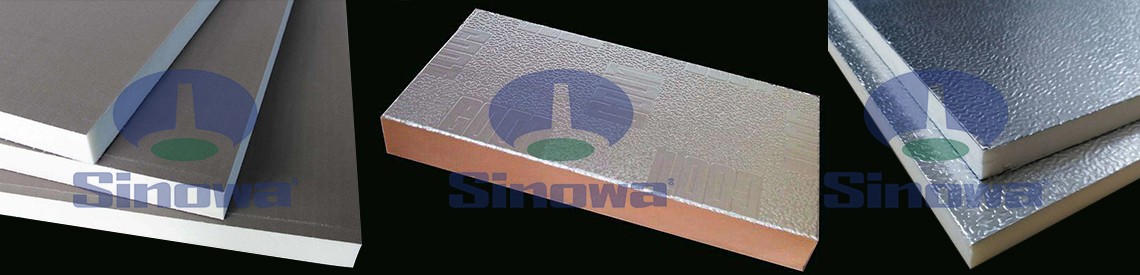
Continuous Insulation Panel Production Line of the PU and phenolic aldehyde surface has diversified and multifunctional production characteristics, which may produce products with different specifications such as PU, PF, PIR, etc.
The surface material may be aluminum foil, colored steel, cement base cloth, kraft paper, non-woven fabrics, etc.
The products are widely applied to such occasions as construction, decoration, pipeline ventilation, subway construction, etc.

The of soft layer insulation board is able to continuously and efficiently produce high-quality PU and Phenolic insulation boards.
We spare no efforts to improve our product quality and technological reliability by employing the most cutting-edge and the most reliable support and processes to make our products highly reliable and endurable. As a result, the of our soft layer insulation panels is highlighted by many perfect qualities. It is the core idea in Sinowa's product roadmap to surpass our competitors in terms of design philosophy, manufacture methods and service level, going for excellence and leading position and making constant improvement on our products and services, which is also our core value system to create efficiency and convenience for our customers.

Well-grounded on our solid strength as a renowned large-scale enterprise, Sinowa has a high starting point in developing industrial assembly lines.
Based on the advanced science and technology introduced from within and without the country and supported by a great number of first-grade parts and components from the home and aboard, these assembly lines have a high-level configuration of supporting products in terms of machinery, electrical control, hydraulic pressure, automatic measurement and tracking, and so on.
This is a strong proof of our product’s reliable quality and high efficiency.

The first-class appearance design and excellent energy saving measures make it unnecessary for customers to additionally construct the heat preservation and isolation room for production around the clock throughout the year, so that the customers may save lots of resources and costs.
Modularized standard design and important parts machined with CNC machine tool make the production line have excellent quality assurance. Dependence on the man-made factors is eliminated. The operation is precision, with the highest operation speed of 30m/min. The has the world-class production efficiency.

The high performance and reliable multicomponent cyclopentane foaming technology and equipment of Sinowa may be also applied to the foaming process of the phenolic aldehyde board. Therefore, our customers may not only freely adjust the foaming matching according to the raw material, but also save lots of costs. Moreover, they are of significance for environmental protection.
Sinowa's industrial of insulation panels is distinguished by its impressive performance of energy conservation. In each high point of energy consumption throughout the entire pu sandwich panel line are implemented corresponding measures to considerably lower the consumption level.

For example, the body of the lamination belt conveyer is covered with insulation panels in very reasonable structures, which doesn’t blemish the overall outlook but greatly increases the insulation performance.
The entire is constantly optimized and improved so that the consumption of each power source is significantly reduced. The motor power of our lamination conveying system is only 3.0 kw, about 50% less than those of the same kind.
All in all, the energy consumption of the whole sandwich panel line equals 40% or even less of the equivalent lines in the market.

The of Sinowa adopts the most advanced concepts in the world to realize the modularized design with all the parts bolted together rather than welded.
In standardized production, the parts can be dismantled and exchanged, so the production cycle is drastically shortened and the maintenance becomes by far easier.
Through finite element analysis, the equipment design is greatly optimized to realize modularization, digitization, and weight-minimalization.
| PRODUCTION TYPE | PU | PIR | PHENOLIC | |||
|---|---|---|---|---|---|---|
| PRODUCTION USE | INSULATION PANEL | DOCORATIVE PANEL | ||||
| SURFACE OF SHEET | ALUMINUM FOIL | NON-WOVEN FABRIC | PAPER | NAKED | ||
| PRODUCT THICKNESS | 10m--- 200mm | |||||
| PRODUCTION SPEED | 3.0m---25m |
|---|---|
| FOAMING METHOD | TWO OR MULTI COMPONENTS FOAMING |
| FOAMING AGENT | PENTANE OR 141B |
| LENGTH OF LINE | 45m—100m CUSTOMER OPTIONAL |
Sinowa is a well-known manufacturer and technical service provider of high-end polyurethane insulation board production lines and various high-performance cold roll forming machine in China. Our main products include polyurethane double-sided color steel sandwich panel production line, polyurethane and phenolic soft facing insulation panel production line and high-efficiency roll forming machines.
Sinowa has invested outstanding efforts in phenolic foam sandwich panel production line, This is why our products are more efficiency, quality, automatic control technology, environmental protection, energy consumption indicators and the appearance and safety protection are comprehensively leading, Some subversive design changes in many major technical points,these major innovations make our products excellent in price/performance and user experience.
Sinowa is committed to the development and manufacturing of high-end and high-efficiency phenolic foam sandwich panel production line. Our sandwich panel production lines are leading the way in efficiency, automatic control, human-computer interaction, environmental protection and energy consumption. Using system integration and bus control technology, it realizes the automatic integrated linkage control of the entire production line, and can achieve remote interactive communication, which has the world-class level and a comprehensive leading high-performance production line in the market.
The phenolic foam sandwich panel production line represents a sophisticated integrated manufacturing system designed for the continuous and standardized production of composite building panels with phenolic foam as the core insulating layer and flexible or rigid facing materials on both sides. Unlike conventional composite panel production equipment, this specialized production system is tailored to adapt to the unique chemical reaction characteristics of phenolic resin, including its relatively slow foaming speed, strict curing temperature requirements, and precise cross-linking reaction conditions, enabling stable and high-efficiency molding of high-performance phenolic foam sandwich panels. As a core production facility in the modern energy-saving building material industry, it integrates raw material feeding, automatic mixing, continuous pouring, layered composite molding, constant-temperature curing, fixed-length cutting, surface finishing and automatic stacking into one seamless production process, realizing full-cycle automated operation from raw material input to finished product output and effectively meeting the large-scale production demands of architectural insulation, fire protection, and enclosure structure materials.
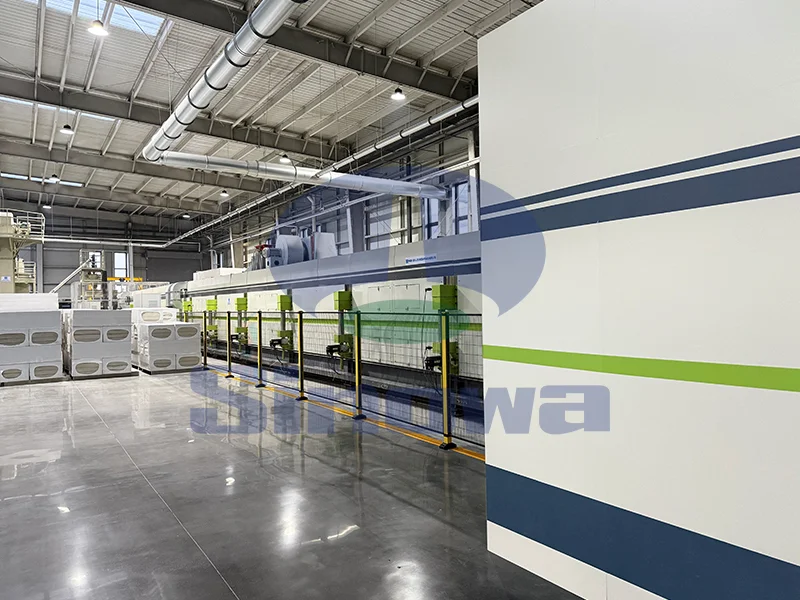
The overall structural design of the production line follows the principles of mechanical integration and process rationalization, with each functional module closely connected and coordinated to ensure the continuity and stability of the production process. The front-end part of the entire production system is responsible for the orderly supply and pre-treatment of raw materials, covering both the surface facing materials and the chemical raw materials required for the phenolic foam core layer. For surface facing materials, the system is equipped with automatic unwinding and leveling devices, which can smoothly release coiled metal sheets, fiber fabrics and other facing materials, and eliminate surface wrinkles, uneven tension and deformation through multi-group leveling structures. This pre-treatment process ensures that the surface materials maintain a flat, tight and uniform tension state in the subsequent composite process, laying a foundation for the flatness and overall uniformity of the final finished panels. The tension control system embedded in the unwinding module can dynamically adjust the discharging speed according to the operating speed of the subsequent production line, avoiding material deviation, stretching damage or overlapping accumulation caused by mismatched speed, and ensuring the synchronous operation of the entire material conveying link.
In terms of core raw material supply, the production line is equipped with independent sealed storage and conveying units for phenolic resin, foaming agents, modifiers and curing agents. All liquid raw materials are stored in sealed constant-temperature tanks to prevent component volatilization, moisture absorption and chemical deterioration caused by external temperature and humidity changes, which may affect the foaming and curing effect of phenolic foam. Each storage tank is matched with a precise quantitative conveying device, which can stably deliver raw materials to the mixing unit according to the preset process proportion. The proportioning accuracy of the system is strictly controlled in the production process, as the ratio of resin, foaming agent and curing agent directly determines the foam pore structure, density uniformity and curing completeness of the phenolic core layer. Slight deviation in proportioning will lead to problems such as uneven foaming, local hollowing, insufficient curing and reduced structural strength of the core material, so the automatic proportioning system adopts real-time monitoring and micro-adjustment functions to maintain the stability of raw material ratio throughout the production process.
The mixing and pouring unit is one of the most critical functional modules of the entire production line, undertaking the core task of raw material homogenization and directional pouring. Different from the mixing process of other foam materials, phenolic foam raw materials require more sufficient shear mixing and uniform fusion to ensure that various additives are evenly distributed in the resin matrix. The high-speed dynamic mixing head adopted by the production line can complete the full fusion of multiple raw materials in an instant, forming a homogeneous liquid mixture with stable activity and uniform components. After mixing, the liquid phenolic mixture is evenly poured onto the flat bottom facing material through a sliding transverse pouring mechanism. The pouring mechanism can reciprocate horizontally along the width direction of the panel, matching the forward conveying speed of the bottom material to realize full-width uniform pouring without dead angles, ensuring the consistent thickness and uniform density of the subsequent foam core layer. The whole pouring process is carried out in a closed environment, which avoids the loss of raw material components caused by external air contact and reduces the impact of environmental factors on the foaming reaction.
After the pouring operation is completed, the production line enters the composite lamination and foaming curing stage, which is the key link to determine the molding quality and structural performance of the sandwich panel. The upper facing material is automatically conveyed and covered on the surface of the poured phenolic mixture through the upper material conveying system, forming a preliminary three-layer composite structure of bottom facing, phenolic mixed liquid and top facing. The composite structure then enters the double-belt continuous pressing and curing system, which is the core equipment that distinguishes the phenolic foam panel production line from ordinary composite panel production lines. Considering the slow expansion and cross-linking curing characteristics of phenolic foam, the double-belt system is designed with an extended curing chamber and multi-stage independent temperature control zones, which can provide stable and graded heating conditions for the foaming and curing reaction.
In the curing chamber, the foam mixture undergoes continuous physical foaming and chemical cross-linking reactions. With the gradual increase of temperature in the staged temperature zones, the foaming agent steadily releases gas to form a uniform closed-cell structure inside the phenolic material, and the phenolic resin undergoes continuous cross-linking and solidification reactions to gradually form a rigid foam core layer with stable structural performance. The double-belt conveyor maintains constant and uniform pressure on the upper and lower surfaces of the composite panel during the whole process, which can effectively restrain the irregular expansion of the foam, ensure the consistent thickness of the panel in the whole width and length direction, and make the upper and lower facing materials closely bonded with the foam core layer without gaps or delamination. The matching of conveyor speed, curing temperature and pressure is extremely precise in this process. The system dynamically adjusts the operating parameters according to the real-time reaction state of the foam, so as to adapt to the slow curing rate of phenolic foam and ensure that the core material is fully cured and cross-linked, thus obtaining excellent dimensional stability, compressive strength and overall bonding performance.
After completing the foaming and curing molding in the constant-temperature curing chamber, the continuously formed long strip composite panel is conveyed to the fixed-length cutting and finishing unit. The high-precision tracking cutting system equipped by the production line can automatically identify the running speed and position of the panel, and complete fixed-length cutting according to the preset dimensional parameters. The cutting tool adopts high-hardness precision blades, which can realize smooth and burr-free cutting of the composite structure of metal surface layer and foam core layer, ensuring flat and neat panel end faces. Meanwhile, the edge trimming device can fine-tune the edge size of the panel to eliminate tiny deformation and dimensional deviation generated in the molding process, making the overall dimensional accuracy of the finished panel meet unified production standards. All cutting and finishing processes are automatically completed by mechanical equipment, which avoids the dimensional error and surface damage caused by manual operation and greatly improves the consistency of product specifications.
The final stage of the production process includes quality inspection, automatic stacking and protective packaging. The production line is equipped with online real-time detection modules, which conduct continuous sampling and inspection on the thickness flatness, surface integrity, bonding tightness and overall flatness of the formed panels. The detection system uses high-sensitivity sensors to collect panel data in real time, automatically identify unqualified products with dimensional deviation, surface scratches or incomplete bonding, and mark and screen them separately to prevent defective products from entering the finished product stack. Qualified finished panels are automatically conveyed to the stacking platform, where the mechanical stacking device neatly stacks the panels according to fixed layers and specifications, realizing orderly arrangement of finished products. Finally, the stacked panels are wrapped with protective packaging materials to prevent surface friction damage, dust adhesion and moisture erosion during transportation and storage, ensuring that the products maintain good surface state and structural performance after leaving the factory.
The overall performance advantages of the phenolic foam sandwich panel production line are mainly reflected in process professionalism, production stability and product performance optimization. Compared with general composite panel production equipment, this production line is specially optimized for the reaction characteristics of phenolic materials. The graded temperature control curing system and low-speed stable pressing mode perfectly adapt to the slow foaming and curing characteristics of phenolic foam, effectively solving the problems of insufficient curing, uneven foaming and easy deformation that are prone to occur in the production of phenolic panels by ordinary production lines. The fully automated closed-loop production process reduces manual intervention links, realizes precise control of each production parameter, and greatly improves the stability and repeatability of product quality. The continuous production mode breaks the limitation of intermittent production, effectively improves production efficiency, and can realize long-term stable operation to meet the market demand for batch supply of phenolic foam sandwich panels.
In terms of production energy consumption and environmental protection, the production line adopts optimized structural design and energy-saving temperature control mode. The multi-stage zoning heating structure can accurately control the temperature of each reaction section, avoiding the energy waste caused by overall high-temperature heating of the traditional integrated curing system. Meanwhile, the closed raw material conveying and mixing structure effectively reduces the volatilization of raw material components in the production process, reduces the generation of excess waste gas and waste residue, and realizes green and low-consumption production. The production process produces few waste materials, and the leftover materials generated by cutting can be recycled and reused after centralized collection, which further improves the utilization rate of raw materials and reduces the production cost of enterprises.
The products manufactured by this professional production line have outstanding comprehensive performance, which is inseparable from the precise process control of the entire production system. The phenolic foam core layer formed by precise proportioning and graded curing has a uniform closed-cell structure, endowing the panel with excellent thermal insulation and heat preservation performance, which can effectively reduce the heat transfer efficiency of building enclosure structures and achieve good energy-saving effects. At the same time, the fully cross-linked phenolic resin structure makes the core material have excellent fire resistance and high temperature resistance, with stable structural performance in high-temperature environments, not easy to burn and melt, which can improve the overall fire safety of buildings. In addition, the tight composite structure formed by one-time continuous pressing makes the surface layer and the core layer have high bonding strength, avoiding delamination and cracking in long-term use, and ensuring the long-term dimensional stability and structural durability of the panel.
With the continuous improvement of the requirements for building energy conservation, fire safety and environmental protection performance in the construction industry, the market demand for high-performance phenolic foam sandwich panels is constantly increasing, and the professional phenolic foam sandwich panel production line has gradually become the core supporting equipment for the production of high-end energy-saving building materials. Its automated, precise and green production characteristics not only improve the production efficiency and product quality level of the industry, but also promote the standardized and large-scale development of the phenolic composite panel manufacturing field. In the actual production and application, the production line can adjust process parameters such as raw material proportioning, curing temperature, pressing pressure and panel specifications according to different use scenarios and product performance requirements, realizing flexible production of diversified products and meeting the personalized material demand of different construction projects.
In conclusion, the phenolic foam sandwich panel production line is a highly professional and integrated intelligent production system. Through the organic cooperation of multiple functional modules such as raw material pretreatment, precise proportioning and mixing, continuous composite molding, graded curing and forming, and automatic finishing and packaging, it realizes efficient and standardized production of high-performance phenolic foam sandwich panels. Its unique process design targeting the characteristics of phenolic materials makes up for the deficiencies of traditional composite panel production equipment in the production of phenolic products, and the produced panels have significant advantages in thermal insulation, fire resistance, structural stability and durability. With the continuous upgrading of building material manufacturing technology and the continuous improvement of industry environmental protection and energy-saving standards, this type of production line will continue to play an important role in the field of energy-saving building material production, and continuously promote the technological progress and high-quality development of the construction supporting material industry.
«Phenolic Foam Sandwich Panel Production Line» Update Date:2026/6/2
URL: https://www.sinowa.cn/en/blog/phenolic-foam-sandwich-panel-production-line.html