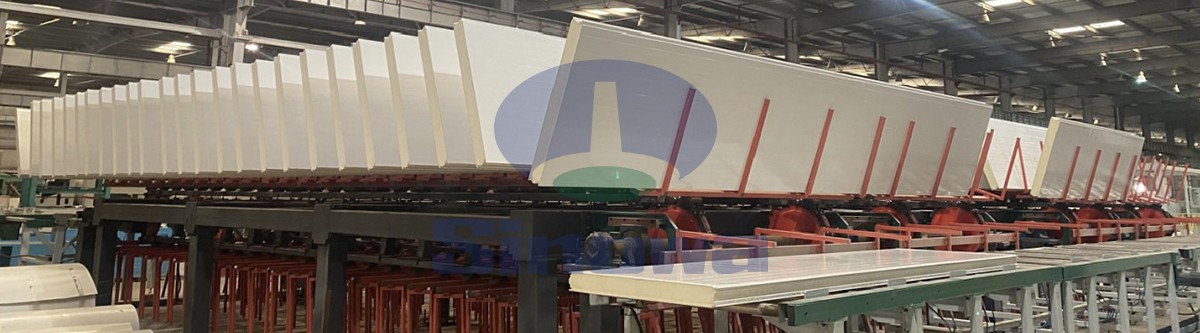
Sinowa is a well-known Sandwich Panel Line Supplier From China, Dedicated to the research and development of high-end & high-efficiency sandwich panel line, Sinowa is comprehensively taking the leading position in terms of efficiency, automation control level, HMI, environment protection and energy consumption, with subversive designs made in some critical technological fields to procure exceptional cost performance and customer-friendly experience for the entire sandwich panel line.
The adoption of system integration technology and bus control technology accomplishes the full automatization of integrated and coordinated control of the entire sandwich panel line with accessible remote interactive communication. Ranking the first-class level in the world, it is currently the continuous pu sandwich panel line in the market taking a comprehensive lead in high performance.

Based on the continuous technological pursuit, the sandwich panel line developed by Sinowa provides you with high-efficiency industrial value. Based on China's cost advantage and our hard-working technology concept, our sandwich panel production line has a world-leading price-performance advantage. Sandwich Panel Line can meet a variety of production needs of customers.The whole sandwich panel line design concept of modularization enables all our components to be integrated and combined at will.
Our sandwich panel line can easily automate the production of roof sandwich panel, wall sandwich panel, cold storage sandwich panel and other products by different combination and configuration selection and siple switching. The inner core layer can be polyrethane or rock wool, glass wool, an so on.

The sandwich panel line has high adaptability, which may produce various sandwich panel of the PU, PIR and rock wool systems.
We may design various products according to the customer’s requirements, including various configurations, so as to meet their demands with flexible price system.
Highly integrated and linked control system centralizes all control points at the main central center, achieving parameter linkage, fault self-diagnosis controlled by the whole continuous sandwich panel line and shipping distance control.
High-level automatic control system also saves the manpower and reduces the manpower loss for customers.

Concentrated system control is fully realized in the practice of concentrated process control so that the control system of all the movements of the parts in the sandwich panel line is integrated in one process control console with accessible remote communication to elevate the automation and reduce the allocated number of personnel for the assembly line.
The main engine with modularized design achieves the precision operation of the sandwich panel line, stable and reliable quality, less part and maintenance loss.

The whole sandwich panel line is strictly modularized in design to ensure the greatest probability for the parts to be interchangeable, making it the most cost- and energy-saving. No joining made manually, all the key processes of the parts are completed in the machining center. As soon as the parts are inspected and warehoused, they enter into the assembly process. The modularized assembly can not only greatly increase the production efficiency but, most importantly, realize quick delivery as well. It elevates the reliability of product quality to a totally new level and minimizes the influence from human factors.
The whole sandwich panel line has over 40 innovative inventions, making our products have lots of unique features and the comprehensive performance of our production line leading in the industry.

The precision servo hoisting mechanism employed by the main engine without hydraulic system makes the board thickness control flexible and the customer may conveniently change or adjust the board thickness. There will be not such troubles as hydraulic system adjustment, leakage, maintenance, etc.
High-level energy saving and protection design makes the whole sandwich panel line possible to produce around the clock throughout the year and the customer will save huge budget. In addition, the isolated heat preservation room is constructed for warming the environment. The energy saving and protection design of our high-tech sandwich panel line may guarantee that the customer’s production line may be freely heated and produce in the main time to save more costs for customers.

The high-power low-consumption design quickens the reaction of the sandwich panel line while energy consumption is kept low.
With the brand-new, fully sealed inner insulation design, the energy consumption is controlled at the minimum level to achieve the design objective of less than an hour for the insulation system to be activated from the room temperature above 5℃ to the production process temperature.
The energy consumption is only 40% that of those similar products.
| PRODUCTION TYPE | PU | PIR | PHENOLIC | |||
|---|---|---|---|---|---|---|
| PRODUCTION USE | INSULATION PANEL | DOCORATIVE PANEL | ||||
| SURFACE OF SHEET | ALUMINUM FOIL | NON-WOVEN FABRIC | PAPER | NAKED | ||
| PRODUCT THICKNESS | 10m--- 200mm | |||||
| PRODUCTION SPEED | 3.0m---25m |
|---|---|
| FOAMING METHOD | TWO OR MULTI COMPONENTS FOAMING |
| FOAMING AGENT | PENTANE OR 141B |
| LENGTH OF LINE | 45m—100m CUSTOMER OPTIONAL |
Sinowa is a well-known manufacturer and technical service provider of high-end polyurethane insulation board production lines and various high-performance cold roll forming machine in China. Our main products include polyurethane double-sided color steel sandwich panel production line, polyurethane and phenolic soft facing insulation panel production line and high-efficiency roll forming machines.
Sinowa has invested outstanding efforts in both the insulation board production line and the roll forming line, This is why our products are more efficiency, quality, automatic control technology, environmental protection, energy consumption indicators and the appearance and safety protection are comprehensively leading, Some subversive design changes in many major technical points,these major innovations make our products excellent in price/performance and user experience.
Sinowa is committed to the development and manufacturing of high-end and high-efficiency sandwich panel production lines. Our sandwich panel production lines are leading the way in efficiency, automatic control, human-computer interaction, environmental protection and energy consumption. Using system integration and bus control technology, it realizes the automatic integrated linkage control of the entire production line, and can achieve remote interactive communication, which has the world-class level and a comprehensive leading high-performance production line in the market.
The design of sandwich panel production lines stands as a comprehensive engineering discipline that integrates mechanical structure optimization, material flow control, thermal processing technology, and automated motion coordination. As sandwich panels gain widespread application in modern construction, industrial enclosure manufacturing, and thermal insulation engineering, the rationality of production line design directly determines production efficiency, product structural consistency, raw material utilization rate, and long-term operational stability. A well-designed production line is not merely a combination of independent mechanical units but an interconnected system that realizes continuous, stable, and standardized molding of composite plates through precise process logic and mechanical matching. The core objective of line design is to balance production continuity, structural adaptability, and operational controllability while eliminating unnecessary mechanical redundancy and process links to create an efficient and low-consumption manufacturing system.
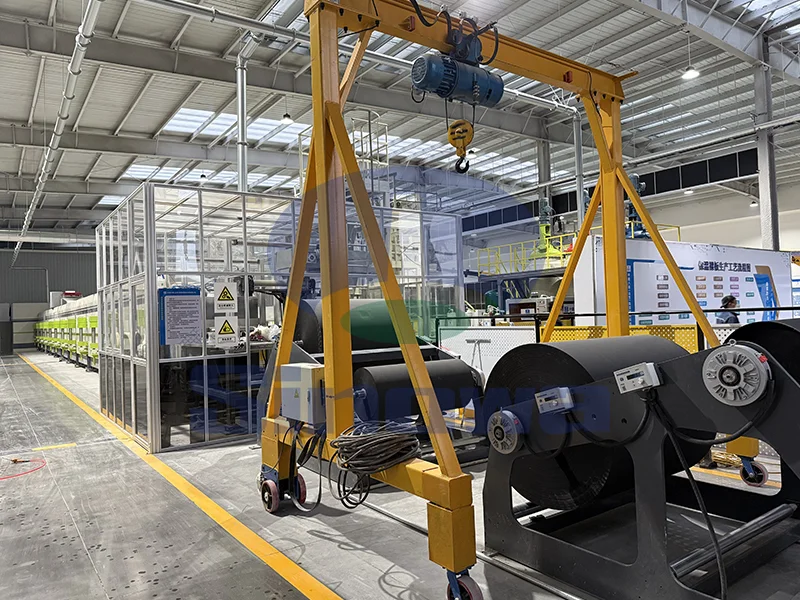
The fundamental design logic of sandwich panel lines originates from the structural characteristics of sandwich panels themselves. A typical sandwich panel consists of two rigid surface layers and a lightweight core material, where the surface layers provide tensile and bending resistance for the overall plate structure, and the core material undertakes thermal insulation, shock absorption, and pressure dispersion functions. Based on this composite structure, the production line must complete a series of sequential processes including surface material pretreatment, core material preparation, composite lamination, thermal curing, dimensional shaping, and fixed-length cutting. Every structural module in the production line needs to be designed with compatibility for different material attributes, as surface materials may include metal sheets and non-metal decorative substrates, while core materials cover foam polymers, inorganic fibrous materials, and lightweight granular aggregates. Designers must fully consider the physical properties of diverse raw materials such as surface tension, fluidity, heat sensitivity, and compression resistance to formulate targeted mechanical transmission and processing schemes.
Raw material processing and feeding systems constitute the front-end core part of sandwich panel line design, laying the foundation for continuous and stable production. For surface layer substrates, the feeding unit adopts a roll unwinding structure with dynamic tension control to avoid wrinkling, stretching, and lateral deviation of thin plates during high-speed transmission. The tension adjustment mechanism is designed with elastic buffer components and synchronous sensing modules to adapt to subtle changes in substrate hardness and thickness, ensuring flat and orderly transportation of surface materials to the composite station. Meanwhile, the pretreatment section for surface materials incorporates dust removal, surface smoothing, and adhesive coating processes. The dust removal structure relies on circulating air flow and static elimination components to remove tiny particles and impurities attached to the substrate surface, while the smoothing unit uses precision roller sets to eliminate subtle warping and indentations. Adhesive coating modules adopt roller coating technology, and the gap between coating rollers is accurately calibrated to form a uniform adhesive film on the substrate surface, which strengthens the bonding tightness between the surface layer and core material and avoids delamination defects in finished plates.
In terms of core material feeding and mixing design, different structural layouts are formulated according to core material types. For fluid foaming core materials, the system is equipped with sealed metering and high-speed mixing structures. Multiple raw material components are delivered to the mixing cavity through independent conveying pipelines, and precision metering components control the feeding proportion of each raw material to ensure the uniformity of mixed materials. The internal structure of the mixing cavity adopts a curved flow channel design to extend the mixing stroke of raw materials, and high-speed rotating stirring blades break up material agglomerations to achieve microscopic homogeneous mixing. For solid lightweight core materials such as fibrous and granular materials, the feeding system is configured with vibration screening and quantitative conveying structures. Vibration equipment screens out oversized particles and impurities to ensure consistent core material fineness, while variable-frequency conveying equipment adjusts the feeding speed according to the production line operating rhythm to maintain stable stacking density of core materials between double-layer surface materials. All feeding modules are designed with closed protective structures to reduce material splashing loss and isolate external dust interference.
The composite molding system is the central functional section of the entire production line, and its structural design determines the bonding strength and flatness of sandwich panels. A mature composite molding unit usually adopts a double-belt clamping transmission structure, where upper and lower circulating belts form a relatively closed molding cavity. After the pre-treated surface materials and mixed core materials enter the cavity synchronously, the belts apply uniform and continuous vertical pressure to the composite plates. The pressure control system is designed with multi-point pressure sensing components, which monitor the stress distribution on the plate surface in real time and automatically adjust the telescopic stroke of hydraulic driving parts to keep the pressure within a reasonable range. This design effectively prevents core material compression deformation and surface layer cracking caused by excessive pressure, while avoiding hollow gaps and weak bonding problems due to insufficient pressure. The internal space of the molding cavity can be adaptively adjusted according to the designed thickness of the sandwich panel, and the linear guide rail structure ensures the synchronization accuracy of upper and lower belt displacement, realizing flexible switching of plate thickness specifications.
Thermal curing design is an indispensable link for stabilizing the composite structure of sandwich panels, especially for plates requiring chemical foaming and adhesive curing reactions. The curing section adopts an integrated heat preservation box structure, and the internal space is divided into multiple temperature gradient areas to complete low-temperature foaming, medium-temperature curing, and high-temperature shaping processes in sequence. The heating system uses circulating heat conduction components to evenly distribute heat in the cavity, avoiding local overheating that causes core material carbonization and surface layer discoloration. Temperature sensing elements are arranged at multiple positions inside the curing box to collect real-time temperature data, and the intelligent control system dynamically adjusts heating power to maintain temperature stability within each gradient area. In addition to temperature control, the curing section is equipped with air circulation and moisture removal structures to discharge water vapor and chemical gas generated during material reaction, reducing internal bubble defects inside the plates and improving the compactness of the composite structure. The length of the curing section is matched with the production line operating speed, ensuring that each plate stays in the constant temperature cavity long enough to complete the curing reaction.
The trimming and cutting system, as the post-processing unit of the production line, focuses on dimensional accuracy and edge flatness in structural design. After the composite plates are initially shaped, bilateral trimming devices first polish and cut the uneven edges on both sides. The trimming tool adopts high-hardness integral blades, and the sliding rail structure drives the tool to move synchronously with the plates to ensure linear cutting trajectories. The gap between the trimming mechanism and the transmission belt is precisely calibrated to avoid scratching the surface coating of the plates. The fixed-length cutting unit uses synchronous flying shear structures; the cutting tool moves forward synchronously with the continuously transmitted plates during the cutting process, completing instantaneous shearing and then automatically resetting. This dynamic cutting mode eliminates the need to stop the production line, realizing uninterrupted continuous production. The cutting system is equipped with high-precision ranging sensors to identify plate length in real time, and the control system records cutting data to realize standardized production of plates with fixed specifications.
In the overall layout design of sandwich panel lines, spatial planning and process sequence optimization need to be emphasized. The production line adopts a horizontal linear layout to reduce the turning and lifting links of materials, lowering the risk of plate deformation and position deviation during transmission. According to the process sequence, functional modules are arranged in an orderly manner from front to back, and independent buffer sections are reserved between adjacent units to avoid production stagnation caused by abnormal fluctuations in individual links. The bottom of all mechanical units is equipped with shock-absorbing support structures to reduce vibration resonance during high-speed operation, preventing vibration from affecting the bonding accuracy and cutting flatness of plates. In terms of power distribution, the production line adopts a decentralized driving mode; each functional module is equipped with independent power components, and the central control system realizes synchronous speed matching of all units through signal linkage, ensuring the consistency of material transmission rhythm throughout the line.
Automation and intelligent optimization are key directions in modern sandwich panel line design. The entire production line is equipped with a centralized control system, and human-computer interaction terminals display operating parameters such as transmission speed, molding pressure, curing temperature, and cutting dimensions in real time. Designers set up intelligent monitoring nodes at key process positions to identify abnormal conditions such as material blockage, pressure overload, and temperature deviation. Once abnormal data is detected, the system automatically triggers early warning prompts and performs micro-adjustments to operating parameters, reducing manual intervention frequency. The motion execution components mostly adopt servo driving structures, which have the advantages of high positioning accuracy and stable running speed, and can accurately complete subtle actions such as material feeding, pressure adjustment, and tool positioning. In addition, the data recording function is embedded in the control system to store production parameter information of each batch of products, providing data support for subsequent production optimization and quality tracing.
Energy consumption control and environmental protection optimization are important indicators that cannot be ignored in production line design. In terms of energy saving, the heating section adopts thermal insulation lining structures to reduce heat loss, and waste heat generated during curing is recycled to the preheating area of the raw material section through circulation pipelines, improving energy utilization efficiency. The transmission motors of each unit are equipped with frequency conversion adjustment modules, which automatically reduce operating power during low-load operation to avoid energy waste caused by long-term constant-speed operation. In terms of environmental protection, all material mixing and feeding units adopt fully sealed structures to prevent dust and volatile gases from escaping. A centralized waste collection device is installed at the trimming and cutting positions to uniformly recover edge scraps and leftover materials, realizing resource recycling. The noise generated by mechanical operation is reduced through shock absorption structures and mute transmission accessories, meeting the noise control standards of industrial production environments.
Maintenance convenience and structural scalability should also be fully considered in the design process of sandwich panel lines. The mechanical structure adopts a modular assembly design, and each independent functional unit is connected by detachable connectors, which facilitates daily disassembly, cleaning, and replacement of vulnerable parts. The surface of mechanical components is treated with anti-corrosion and wear-resistant coatings to adapt to humid and dusty industrial production environments and extend the service life of equipment. The reserved expansion interfaces are designed on both the hardware and software levels of the production line; later, functional modules such as surface embossing and anti-corrosion coating can be added according to production demands, and the control system can complete program upgrading and parameter expansion without overall transformation. This scalable design enables the production line to adapt to the iterative upgrading trend of sandwich panel products and improve the long-term use value of equipment.
In practical application scenarios, the design scheme of sandwich panel lines needs to be dynamically adjusted according to production positioning. For mass production of conventional building insulation panels, the production line focuses on high-speed continuous operation, and the structural design simplifies redundant adjustment links to improve production cycle efficiency. For customized special-shaped panels with high precision requirements, the production line increases the number of sensing and fine-tuning components, optimizes the motion accuracy of cutting and trimming structures, and enhances the adaptability of complex production processes. Regardless of the design orientation, the core design philosophy always adheres to the coordination of mechanical performance, material adaptability, and operational controllability, minimizing unstable factors in the production process.
With the continuous upgrading of composite material technology and manufacturing industry standards, the design of sandwich panel lines is evolving toward higher precision, lower energy consumption, and stronger intelligence. Future design optimization will focus on intelligent material identification, automatic parameter matching, and unmanned operation management. By introducing more high-precision sensing elements and intelligent algorithm models, the production line can independently identify raw material attribute changes and automatically adjust process parameters such as pressure, temperature, and speed to further improve the yield and consistency of finished products. At the same time, combined with lightweight mechanical design and renewable energy utilization technology, the energy consumption and carbon emission of the production process will be continuously reduced, realizing the green and sustainable development of sandwich panel manufacturing industry. As an important carrier of composite plate production, scientific and reasonable line design will continuously provide reliable technical support for the popularization and performance upgrading of sandwich panels in various industrial fields.
«Sandwich Panel Lines Design» Update Date:2026/5/11
URL: https://www.sinowa.cn/en/blog/sandwich-panel-lines-design.html
Tags: Foam Core Sandwich Panel Line , PU Sandwich Panel Lines , Rockwool Sandwich Panel Line , PIR Sandwich Panel Line , Rock Wool Sandwich Panel Line , Insulated Sandwich Panel Lines , Polyurethane Sandwich Panel Line , Mineral Wool Sandwich Panel Line , Continuous Sandwich Panel Line , Continuous PU Sandwich Panel Line ,