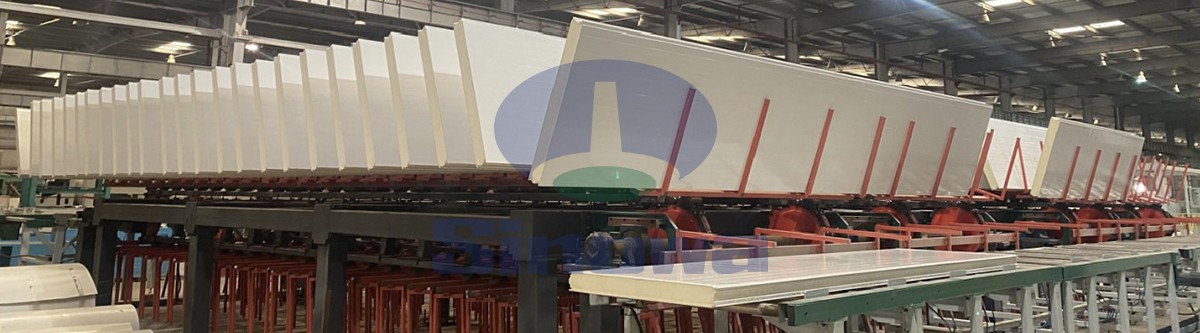
Sinowa is a well-known PU Sandwich Panel Machine Supplier From China, Dedicated to the research and development of high-end & high-efficiency pu sandwich panel machine, Sinowa is comprehensively taking the leading position in terms of efficiency, automation control level, HMI, environment protection and energy consumption, with subversive designs made in some critical technological fields to procure exceptional cost performance and customer-friendly experience for the entire pu sandwich panel machine.
The adoption of system integration technology and bus control technology accomplishes the full automatization of integrated and coordinated control of the entire pu sandwich panel machine with accessible remote interactive communication. Ranking the first-class level in the world, it is currently the continuous pu sandwich panel line in the market taking a comprehensive lead in high performance.

Based on the continuous technological pursuit, the pu sandwich panel machine developed by Sinowa provides you with high-efficiency industrial value. Based on China's cost advantage and our hard-working technology concept, our sandwich panel production line has a world-leading price-performance advantage. PU Sandwich Panel Machine can meet a variety of production needs of customers.The whole sandwich panel line design concept of modularization enables all our components to be integrated and combined at will.
Our pu sandwich panel machine can easily automate the production of roof sandwich panel, wall sandwich panel, cold storage sandwich panel and other products by different combination and configuration selection and siple switching. The inner core layer can be polyrethane or rock wool, glass wool, an so on.

The pu sandwich panel machine has high adaptability, which may produce various sandwich panel of the PU, PIR and rock wool systems.
We may design various products according to the customer’s requirements, including various configurations, so as to meet their demands with flexible price system.
Highly integrated and linked control system centralizes all control points at the main central center, achieving parameter linkage, fault self-diagnosis controlled by the whole continuous sandwich panel line and shipping distance control.
High-level automatic control system also saves the manpower and reduces the manpower loss for customers.

Concentrated system control is fully realized in the practice of concentrated process control so that the control system of all the movements of the parts in the pu sandwich panel machine is integrated in one process control console with accessible remote communication to elevate the automation and reduce the allocated number of personnel for the assembly line.
The main engine with modularized design achieves the precision operation of the pu sandwich panel machine, stable and reliable quality, less part and maintenance loss.

The whole pu sandwich panel machine is strictly modularized in design to ensure the greatest probability for the parts to be interchangeable, making it the most cost- and energy-saving. No joining made manually, all the key processes of the parts are completed in the machining center. As soon as the parts are inspected and warehoused, they enter into the assembly process. The modularized assembly can not only greatly increase the production efficiency but, most importantly, realize quick delivery as well. It elevates the reliability of product quality to a totally new level and minimizes the influence from human factors.
The whole pu sandwich panel machine has over 40 innovative inventions, making our products have lots of unique features and the comprehensive performance of our production line leading in the industry.

The precision servo hoisting mechanism employed by the main engine without hydraulic system makes the board thickness control flexible and the customer may conveniently change or adjust the board thickness. There will be not such troubles as hydraulic system adjustment, leakage, maintenance, etc.
High-level energy saving and protection design makes the whole pu sandwich panel machine possible to produce around the clock throughout the year and the customer will save huge budget. In addition, the isolated heat preservation room is constructed for warming the environment. The energy saving and protection design of our high-tech pu sandwich panel machine may guarantee that the customer’s production line may be freely heated and produce in the main time to save more costs for customers.

The high-power low-consumption design quickens the reaction of the pu sandwich panel machine while energy consumption is kept low.
With the brand-new, fully sealed inner insulation design, the energy consumption is controlled at the minimum level to achieve the design objective of less than an hour for the insulation system to be activated from the room temperature above 5℃ to the production process temperature.
The energy consumption is only 40% that of those similar products.
| PRODUCTION TYPE | PU | PIR | PHENOLIC | |||
|---|---|---|---|---|---|---|
| PRODUCTION USE | INSULATION PANEL | DOCORATIVE PANEL | ||||
| SURFACE OF SHEET | ALUMINUM FOIL | NON-WOVEN FABRIC | PAPER | NAKED | ||
| PRODUCT THICKNESS | 10m--- 200mm | |||||
| PRODUCTION SPEED | 3.0m---25m |
|---|---|
| FOAMING METHOD | TWO OR MULTI COMPONENTS FOAMING |
| FOAMING AGENT | PENTANE OR 141B |
| LENGTH OF LINE | 45m—100m CUSTOMER OPTIONAL |
Sinowa is a well-known manufacturer and technical service provider of high-end polyurethane insulation board production lines and various high-performance cold roll forming machine in China. Our main products include polyurethane double-sided color steel sandwich panel production line, polyurethane and phenolic soft facing insulation panel production line and high-efficiency roll forming machines.
Sinowa has invested outstanding efforts in both the insulation board production line and the roll forming line, This is why our products are more efficiency, quality, automatic control technology, environmental protection, energy consumption indicators and the appearance and safety protection are comprehensively leading, Some subversive design changes in many major technical points,these major innovations make our products excellent in price/performance and user experience.
Sinowa is committed to the development and manufacturing of high-end and high-efficiency sandwich panel production lines. Our sandwich panel production lines are leading the way in efficiency, automatic control, human-computer interaction, environmental protection and energy consumption. Using system integration and bus control technology, it realizes the automatic integrated linkage control of the entire production line, and can achieve remote interactive communication, which has the world-class level and a comprehensive leading high-performance production line in the market.
PU sandwich panel machines represent a cornerstone of modern building material manufacturing, and China has emerged as a leading global hub for their design, production, and export. These automated production lines integrate polyurethane foaming, lamination, and cutting technologies to deliver insulated panels used across industrial, commercial, and residential construction worldwide.
Polyurethane sandwich panels are composite building materials consisting of two rigid metal facing sheets—typically pre-painted steel, aluminum, or stainless steel—bonded to a continuous core of rigid polyurethane foam. The core is renowned for its exceptional thermal insulation performance, low thermal conductivity, and lightweight structural properties. Unlike traditional insulation methods that require separate installation of insulation boards and facing materials, PU sandwich panels combine insulation, weather resistance, and structural rigidity in a single prefabricated unit. This integration dramatically reduces on-site construction time and labor costs. These panels are widely used in industrial workshops, cold storage facilities, clean rooms, prefabricated houses, supermarket cold chain systems, and modular buildings. In cold storage applications, the high insulation efficiency of polyurethane helps maintain precise temperature control while minimizing energy consumption for refrigeration. In clean room environments, the smooth, non-porous surface of the panels supports hygiene standards and easy cleaning. The versatility of PU sandwich panels has driven sustained global demand, which in turn has stimulated the development of sophisticated manufacturing machinery capable of producing panels at scale with consistent quality.
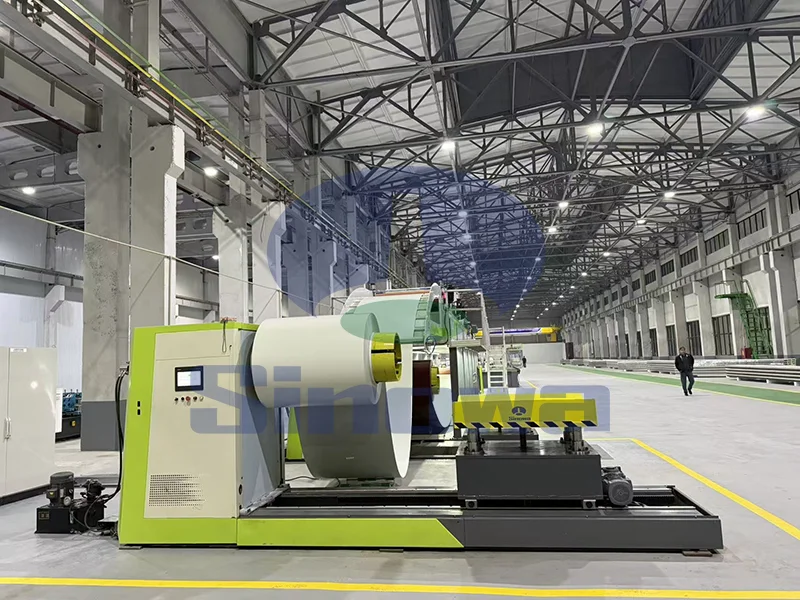
A PU sandwich panel production line is a highly integrated mechanical system that orchestrates multiple sequential processes into a continuous automated operation. The machine typically comprises several principal sections: an uncoiling and feeding system for the metal coils, a pre-cutting and forming station that shapes the facing sheets into the desired profile, a polyurethane foaming and injection chamber where the chemical reaction occurs, a double conveyor belt laminator that maintains dimensional precision during the foam expansion and curing phase, a cross-cutting saw that trims the panels to exact lengths, and an output stacking and packing station. The uncoiler must handle heavy metal coils—often weighing several tons each—with smooth, tension-controlled feeding to prevent wrinkling or deformation of the coated surface. The roll forming stations use a series of precisely engineered rollers to progressively bend the flat metal sheet into the intended corrugated or flat profile. The foaming section is the heart of the line, where polyol and isocyanate components are mixed at precise ratios and injected between the two facing sheets. The double belt conveyor applies uniform pressure and controlled temperature as the foam expands and cures, ensuring the core density is consistent throughout the panel and the bond between the foam and facing sheets is strong and durable. The entire line is controlled by a programmable logic controller with a human-machine interface, allowing operators to set panel width, thickness, length, speed, and foam density parameters from a centralized console.
The production process begins when metal coils are loaded onto automatic uncoilers, which feed the top and bottom sheets into pre-treatment stations. These stations may include pre-heating rollers that bring the metal sheets to the optimal temperature for foam adhesion, as the chemical reaction of polyurethane is temperature-sensitive. The sheets then pass through roll forming machines that shape them into the required profile—whether a flat wall panel, a corrugated roof panel, or a distinctive concealed-fascia design. As the formed sheets travel along the conveyor, they enter the foaming chamber where high-pressure mixing heads dispense the polyurethane chemical components. The mixed liquid foam spreads evenly across the bottom sheet while the top sheet is simultaneously positioned above. The assembly then enters the double belt laminator, which is typically constructed with high-temperature resistant, non-stick conveyor belts driven by precision speed control systems. Inside the laminator, the foam undergoes rapid expansion and curing under controlled pressure and temperature, creating a rigid, fully bonded core. The length of the laminator determines the curing time available before the panel reaches the cutting station. Once the panel exits the laminator, a flying cross-cutting saw—synchronized with the line speed—cuts the continuous panel to the programmed length with clean, square edges. The finished panels then travel on an output conveyor to a stacking system that automatically arranges them into neat bundles for wrapping and packaging.
Modern PU sandwich panel machines manufactured in China incorporate a range of advanced technical features that have evolved significantly over the past two decades. Many production lines now use high-pressure foaming systems with precision metering pumps that maintain extremely tight tolerances on the polyol-to-isocyanate ratio, ensuring consistent foam density and cell structure batch after batch. The double belt laminators are designed with modular heating zones, each independently controlled, allowing operators to adjust the temperature profile along the curing path to match different panel thicknesses and ambient conditions. Servo-driven roll forming systems replace older mechanical drives in many new lines, delivering faster profile changeover times and greater forming precision. The control systems have also become more sophisticated, with touchscreen interfaces that store recipe parameters for different panel specifications, enabling operators to switch between product configurations with minimal downtime. Energy recovery systems are increasingly integrated into the heating sections, recirculating waste heat to reduce overall energy consumption. Some advanced lines also include online thickness measurement sensors that continuously monitor panel dimensions and automatically adjust the conveyor gap to maintain tolerance. Edge trimming and waste collection systems have been refined to minimize material scrap and ensure clean, factory-ready panel edges.
Precision and quality consistency are critical performance metrics for any PU sandwich panel production line, and Chinese manufacturers have invested heavily in engineering solutions that address these demands. The dimensional accuracy of the panels—including flatness, width consistency, and squared ends—directly affects installation speed and the overall appearance of the finished building. To achieve this, the roll forming sections use hardened, precision-ground rollers made from wear-resistant alloy steel, with bearings designed for high-speed continuous operation. The forming stages are calibrated through computer-aided design simulations that predict metal flow and springback, reducing trial-and-error during profile development. In the laminator, parallelism between the upper and lower belts is maintained within tight tolerances across the entire width of the panel, ensuring uniform foam density from edge to edge. The flying saw systems use encoder tracking and servo control to cut panels while the line is in motion, eliminating the need to stop and start the conveyor for each cut, which both boosts throughput and preserves dimensional accuracy. Many lines also incorporate automatic lubrication systems for critical moving parts, reducing maintenance variability and prolonging mechanical precision over years of operation. Quality verification can include online thickness gauges, edge straightness sensors, and visual inspection stations that flag any surface defects before panels reach the packaging area.
One of the notable strengths of Chinese PU sandwich panel machinery is its ability to support a high degree of customization and production flexibility. Construction projects around the world demand panels in a wide variety of widths, thicknesses, lengths, surface finishes, and profile geometries, and the machinery must accommodate this diversity without excessive reconfiguration. Modern production lines are engineered with quick-change roll forming stations that allow operators to switch between different panel profiles—such as wall panels, roof panels, and ceiling panels—within a relatively short changeover window. The width of the panels can often be adjusted by modifying the side guides and edge folding mechanisms. Panel thickness, which typically ranges from thin interior partitions to thick insulated panels for cold storage, is controlled by adjusting the gap between the laminator belts and the corresponding changes in foam injection volume. The control system stores all these parameters as pre-set recipes, so switching from one product specification to another is as simple as selecting the appropriate recipe from the interface. Surface finish options extend to various pre-painted steel coatings, stainless steel facings, and even embossed or textured finishes that mimic brick, wood, or stone. This flexibility allows panel producers to serve diverse market segments—from budget industrial buildings to high-end architectural applications—all on the same production line, maximizing equipment utilization and return on investment.
Energy efficiency and environmental sustainability have become increasingly important considerations in the design and operation of PU sandwich panel manufacturing equipment. The polyurethane foaming process is energy-intensive, as both the chemical components and the facing sheets need to be maintained at optimal temperatures during production. Chinese machinery manufacturers have responded by developing improved thermal insulation for the foaming and laminating zones, reducing heat loss to the surrounding environment. Some lines now use infrared or contact pre-heating methods that warm only the critical areas rather than heating the entire chamber, lowering energy waste. The drive systems have also evolved: many lines now use variable-frequency drives on conveyor motors, which adjust speed based on actual production demand rather than running at a fixed rate. LED lighting and low-power control systems further reduce the overall electrical footprint. In addition to operational energy savings, equipment manufacturers have developed systems to capture and recycle excess foam overspray and edge trim waste, which can be ground and reused or sent for industrial recycling rather than landfilled. Water-based cleaning systems for the mixing heads have replaced solvent-based cleaning in many newer models, reducing volatile organic compound emissions. These sustainability-focused design choices not only lower the environmental impact of panel production but also reduce long-term operating costs for the factory operator, making the equipment more economically attractive over its service life.
After-sales support and the broader service ecosystem are essential considerations for buyers investing in PU sandwich panel machinery, and Chinese equipment suppliers have developed comprehensive support networks to serve international clients. The installation and commissioning of a production line is a complex undertaking that requires specialized technical expertise; suppliers typically dispatch experienced engineers to the client's facility to supervise mechanical installation, electrical wiring, and system calibration. Training programs are provided for the client's operators and maintenance staff, covering machine operation, routine maintenance, troubleshooting, and safety protocols. Many suppliers maintain spare parts warehouses both domestically and in key overseas markets, ensuring that critical wear parts—such as sealing strips, heating elements, sensor probes, and drive belts—can be shipped quickly when needed. Remote diagnostic capabilities have become increasingly common, with the control systems equipped with network connectivity that allows the supplier's engineering team to access machine parameters, review production logs, and perform software updates from a distance. This remote support significantly reduces downtime for issues that can be resolved without an on-site visit. Suppliers also offer periodic maintenance contracts and inspection services to help clients maximize the lifespan of their equipment. For clients in emerging markets where local technical expertise may be limited, some suppliers provide extended training and even operator placement support to ensure the line runs at optimal productivity from day one.
The global market for PU sandwich panel machinery continues to evolve, shaped by trends in construction methods, building regulations, and supply chain dynamics. The growing demand for prefabricated and modular construction—driven by the need for faster project delivery, reduced on-site labor, and tighter quality control—has been a major growth driver for automated panel production lines. Countries investing in infrastructure expansion, cold chain logistics, and industrial facility development represent key markets for this equipment. Manufacturers are also responding to the trend toward smarter factories by integrating industrial internet of things capabilities into their control systems, enabling production data tracking, predictive maintenance alerts, and performance analytics accessible from mobile devices. Another emerging trend is the development of lines that can handle alternative facing materials and next-generation foam chemistries with improved environmental profiles. As building envelope performance requirements continue to rise, panels with greater insulation efficiency and airtightness are in demand, pushing machinery makers to refine the foaming and laminating processes for thinner, higher-performance cores. The competitive landscape among Chinese machinery producers has also intensified, with manufacturers continuously refining their engineering, expanding their export experience, and offering more competitive total cost of ownership. For businesses considering investment in PU sandwich panel production capacity, understanding these technical and market trends is essential for selecting equipment that will remain productive and adaptable for years to come.
«PU Sandwich Panel Machine China» Update Date:2026/10/13
URL: https://www.sinowa.cn/en/blog/pu-sandwich-panel-machine-china.html
Tags: Continuous PU Sandwich Panel Machine , PU Sandwich Panel Machine ,